Breakfast of Champions - Kurt Vonnegut Jr. (Dell, 1973)
Last night, the Stanford Prison Experiment came up in conversation, which led me to the Milgram experiment, the Third Wave, and the blue eyed/brown eyed exercise. These all dated to the 1960s and early 1970s, which led me to wonder what exactly was going on in the air those days.
(I mean, I sort of know the answer, but seriously...)
Which leads me to Vonnegut. It's been a long time since I've read him, and I guess maybe I had forgotten how eccentric his writing could be.
The novel is the lead up to a momentous meeting between a crazy old science fiction writer and a prosperous businessman that ends with the businessman going postal and eventually (after the action of the novel) the author achieving acclaim and winning a Nobel Prize for Medicine.
Oh, and a huge supporting cast. Including Vonnegut himself, in town to watch his creations on their collision course.
The important part: every character matters and has a real story. No minor character should be treated as minor. In fact, "so many Americans [were] treated by their government as though their lives were disposable [...] because that was the way authors customarily treated bit-part players in their made-up tales." None of this for Vonnegut. Which makes for a whole lot of story. And also illustrations, and commentary, and a matter-of-fact telling of some of the less attractive parts of American culture and history, the way someone in hundreds of years might explain it to a child, or to an alien visitor.
Seems a reasonable way to ring out 2013, I suppose.
Showing posts with label tangents unrelated to the book itself. Show all posts
Showing posts with label tangents unrelated to the book itself. Show all posts
Tuesday, December 31, 2013

Wednesday, December 04, 2013
Two lives, interwoven
Earthly Powers - Anthony Burgess (Simon and Schuster, 1980)
Backstory: for my 21st birthday, I got a collection of things from my birth year -- a bottle of port (still unopened), a VHS copy of Moscow Does Not Believe in Tears (foreign language Academy Award winner), and a first edition of this novel, shortlisted for the Man Booker.
Cut to now, when I finally decided that while just having the book was nice and all, I really ought to read it. And at over 600 pages, it was a slog. (Especially with YA dystopias and engagements and colds and holidays and such to distract me.) And my description was probably less than glowing: "It's about a gay writer in the 20th century and his brother-in-law the Pope."
This is more or less accurate. It's about two intertwined families throughout the century, as narrated by the aging homosexual novelist. His brother was a comedian, his sister best described (for the moment) as the wife of an Italian musician. Said musician had one brother a businessman in Chicago, another a priest, and a sister who was a nun. Toomey (the author's) family came from British and French Catholic stock, and so faith (and sexuality) are interwoven throughout the novel.
We know from the start that Carlo the priest will eventually ascend to the head of the Church. But the path there is convoluted for them all. And because I read in small doses, Toomey's recollections from 1918 to roughly the early 1970s seemed to take almost the 50 years they spanned. Which is not to say the writing wasn't sharp and interesting, it was just dense. And heavy. It's an accomplished and successful family, but also a somewhat cursed one, and people's seemingly small and benevolent actions consistently have violent and dreadful ramifications that could not be foreseen. It gets a little rough.
But all in all still fascinating. And a lovely birthday gift, even all these years later.
Backstory: for my 21st birthday, I got a collection of things from my birth year -- a bottle of port (still unopened), a VHS copy of Moscow Does Not Believe in Tears (foreign language Academy Award winner), and a first edition of this novel, shortlisted for the Man Booker.
Cut to now, when I finally decided that while just having the book was nice and all, I really ought to read it. And at over 600 pages, it was a slog. (Especially with YA dystopias and engagements and colds and holidays and such to distract me.) And my description was probably less than glowing: "It's about a gay writer in the 20th century and his brother-in-law the Pope."
This is more or less accurate. It's about two intertwined families throughout the century, as narrated by the aging homosexual novelist. His brother was a comedian, his sister best described (for the moment) as the wife of an Italian musician. Said musician had one brother a businessman in Chicago, another a priest, and a sister who was a nun. Toomey (the author's) family came from British and French Catholic stock, and so faith (and sexuality) are interwoven throughout the novel.
We know from the start that Carlo the priest will eventually ascend to the head of the Church. But the path there is convoluted for them all. And because I read in small doses, Toomey's recollections from 1918 to roughly the early 1970s seemed to take almost the 50 years they spanned. Which is not to say the writing wasn't sharp and interesting, it was just dense. And heavy. It's an accomplished and successful family, but also a somewhat cursed one, and people's seemingly small and benevolent actions consistently have violent and dreadful ramifications that could not be foreseen. It gets a little rough.
But all in all still fascinating. And a lovely birthday gift, even all these years later.
Thursday, November 14, 2013
Shifting allegiances
Insurgent - Veronica Roth (Katherine Tegen Books, 2012)
So, maybe it was the fact that I read Divergent twice in one weekend, but while that book remains vivid in my mind, this one has largely flitted away in the 10 (?) days since I finished it. It was good - not as good as the first one but still - and yet I find myself unable to really write about it.
In all fairness, this may not be the book's fault. Since finishing it, I got engaged (!!!!!) and suddenly almost all my brainpower is devoted to wedding planning. I never expected to be this kind of bride ("oh, I knew you would be," says the fiancé) but here I am so I suppose it's to be expected that this book would get a little lost. Why didn't I write about it sooner?
Moving on. Tris remains pretty awesome, but she's frustrating and difficult in this novel. Maybe I'm overly attached to Four, but (spoiler alert?) a lot of the quieter drama here revolves around how poorly they communicate, and to me it seems like it's almost always her fault. We should cut her some slack though - not only is she a teenager feeling her way into a first relationship, but she's also near the epicenter of the upending of their entire society.
People (both individuals and groups) seem to switch sides pretty often, and villains get complicated. (I approve of this.) I also approve of the continued lack of love triangle, although the cheeseball in me found myself rooting for one. (I like Tris, but I also like antiheroes, and I had a whole thing happening in my head.)
I can't figure out how exactly the last one will turn out, but it's sitting on my coffee table, so if I ever manage to get off the wedding blogs, I guess I will find out.
So, maybe it was the fact that I read Divergent twice in one weekend, but while that book remains vivid in my mind, this one has largely flitted away in the 10 (?) days since I finished it. It was good - not as good as the first one but still - and yet I find myself unable to really write about it.
In all fairness, this may not be the book's fault. Since finishing it, I got engaged (!!!!!) and suddenly almost all my brainpower is devoted to wedding planning. I never expected to be this kind of bride ("oh, I knew you would be," says the fiancé) but here I am so I suppose it's to be expected that this book would get a little lost. Why didn't I write about it sooner?
Moving on. Tris remains pretty awesome, but she's frustrating and difficult in this novel. Maybe I'm overly attached to Four, but (spoiler alert?) a lot of the quieter drama here revolves around how poorly they communicate, and to me it seems like it's almost always her fault. We should cut her some slack though - not only is she a teenager feeling her way into a first relationship, but she's also near the epicenter of the upending of their entire society.
People (both individuals and groups) seem to switch sides pretty often, and villains get complicated. (I approve of this.) I also approve of the continued lack of love triangle, although the cheeseball in me found myself rooting for one. (I like Tris, but I also like antiheroes, and I had a whole thing happening in my head.)
I can't figure out how exactly the last one will turn out, but it's sitting on my coffee table, so if I ever manage to get off the wedding blogs, I guess I will find out.
Friday, April 05, 2013
The descent, and the struggle back
The Bell Jar - Sylvia Plath (Bantam Books, 1971)
One of the things that has made me nuts for years about this book was that I would see "bell jar" and think "bell curve" -- no matter what I did, I couldn't shake that immediate association, and who wants to read a book about depression while you're thinking about statistics and averages and such.
Welcome to my brain, ladies and gentlemen.
This paperback belonged to my mom, and apparently she bought it shortly before her 27th birthday. (It's weird to think of parents as being adults, but still younger than you are now.) None of this is particularly relevant to my review, but I did find myself wondering about the various eras of the book and how it was read... Plath's lightly fictionalized autobiography is about events in the early 1950s, was written mostly in the early '60s before her suicide in 1963, came out in 1971, and here I am reading it 30 years later. Our culture's relationship with mental illness has changed drastically over the past 60 years, and Plath's tale likely played some role in that. Would I have been her, or her alter ego heroine Esther, had I lived in a different time?
Which takes me to the point I wanted to make about this book all along. I was so struck by how much this book reminded me of The Catcher in the Rye. (Of course, I hated that book passionately, and quite liked this one.) Both seem to speak directly to young people, assuring them that others too feel that same sense of alienation from the world around them. (The list of artists and works that do this goes on and on, but for whatever reason, these two seemed perfectly paired.) Even more so, Esther Greenwood, like Holden Caulfield, has a strong (and to my mind unreasonable) abhorrence of hypocrisy and phoniness. This seems particularly strange coming from Esther, who plays the phony game so so well. But man does she judge other people harshly.
I'm babbling quite a bit. I'm glad I finally read The Bell Jar, and can more clearly consider its place in 20th century literature, and society more generally. I also wish I could know how my 16 y.o. self would have met it. Would she have had as little tolerance for Esther as she did Holden? Would she have any idea how much sympathy she would have for her a decade and a half later?
One of the things that has made me nuts for years about this book was that I would see "bell jar" and think "bell curve" -- no matter what I did, I couldn't shake that immediate association, and who wants to read a book about depression while you're thinking about statistics and averages and such.
Welcome to my brain, ladies and gentlemen.
This paperback belonged to my mom, and apparently she bought it shortly before her 27th birthday. (It's weird to think of parents as being adults, but still younger than you are now.) None of this is particularly relevant to my review, but I did find myself wondering about the various eras of the book and how it was read... Plath's lightly fictionalized autobiography is about events in the early 1950s, was written mostly in the early '60s before her suicide in 1963, came out in 1971, and here I am reading it 30 years later. Our culture's relationship with mental illness has changed drastically over the past 60 years, and Plath's tale likely played some role in that. Would I have been her, or her alter ego heroine Esther, had I lived in a different time?
Which takes me to the point I wanted to make about this book all along. I was so struck by how much this book reminded me of The Catcher in the Rye. (Of course, I hated that book passionately, and quite liked this one.) Both seem to speak directly to young people, assuring them that others too feel that same sense of alienation from the world around them. (The list of artists and works that do this goes on and on, but for whatever reason, these two seemed perfectly paired.) Even more so, Esther Greenwood, like Holden Caulfield, has a strong (and to my mind unreasonable) abhorrence of hypocrisy and phoniness. This seems particularly strange coming from Esther, who plays the phony game so so well. But man does she judge other people harshly.
I'm babbling quite a bit. I'm glad I finally read The Bell Jar, and can more clearly consider its place in 20th century literature, and society more generally. I also wish I could know how my 16 y.o. self would have met it. Would she have had as little tolerance for Esther as she did Holden? Would she have any idea how much sympathy she would have for her a decade and a half later?
Friday, March 29, 2013
Hiking the Appalachian Trail, pre-Mark Sanford
A Walk in the Woods: Rediscovering America on the Appalachian Trail - Bill Bryson (Broadway Books, 1998)
Thanks to a certain former South Carolina governor, I have a slightly confused relationship with the Appalachian Trail. And I also had no idea they stretched over 2000 miles of pretty much the entire East Coast. Enter, belatedly, Bill Bryson.
After spending something around two decades in England, Bryson - originally from Iowa - returned to America. And decides a good way to get back into the swing of things would be to hike the entire Appalachian Trail. He makes it sound like it was one of those decisions made mostly on a whim, and that he begin to regret pretty much as soon as he picked up a guidebook. I'm pretty sure it didn't happen quite like this, but anyway...
He and an old (desperately out of shape) childhood friend start out on the journey.
An aside: when I was 19, I found myself in Geneva for a weekend, visiting a friend who had a UN summer internship. (Fancy.) And I joined her and some friends for a daytrip to Gstaadt. As we picnicked, someone had the bright idea to go whitewater rafting. I vetoed this idea as too dangerous, but was talking into trying canyoning, "a nice little hike down to a lake with a waterfall." This was roughly in the same place and about 3 days before this happened. That afternoon was among the most grueling of my life, and I was miserable and cold and wet and scared the entire time. I was also intensely proud of myself for making it through.
This is pretty much how Bryson sounded talking about much of his hike. He definitely did not make me think that this is an adventure I should try. On the other hand, he did tell me a lot more about the geography of the area, the history and (mis)management of the National Park Service, and make me terribly envious of the type of person who would embark on such a challenge. Even more so, it reminded me how little I walk anymore, and how much I truly miss walking. (DC, I will always be grateful.)
Also, and perhaps more pertinently, Bryson is hilarious and witty and such a wonderful voice to spend time with. (As I discovered a couple years back as well.) So glad he exists.
Thanks to a certain former South Carolina governor, I have a slightly confused relationship with the Appalachian Trail. And I also had no idea they stretched over 2000 miles of pretty much the entire East Coast. Enter, belatedly, Bill Bryson.
After spending something around two decades in England, Bryson - originally from Iowa - returned to America. And decides a good way to get back into the swing of things would be to hike the entire Appalachian Trail. He makes it sound like it was one of those decisions made mostly on a whim, and that he begin to regret pretty much as soon as he picked up a guidebook. I'm pretty sure it didn't happen quite like this, but anyway...
He and an old (desperately out of shape) childhood friend start out on the journey.
An aside: when I was 19, I found myself in Geneva for a weekend, visiting a friend who had a UN summer internship. (Fancy.) And I joined her and some friends for a daytrip to Gstaadt. As we picnicked, someone had the bright idea to go whitewater rafting. I vetoed this idea as too dangerous, but was talking into trying canyoning, "a nice little hike down to a lake with a waterfall." This was roughly in the same place and about 3 days before this happened. That afternoon was among the most grueling of my life, and I was miserable and cold and wet and scared the entire time. I was also intensely proud of myself for making it through.
This is pretty much how Bryson sounded talking about much of his hike. He definitely did not make me think that this is an adventure I should try. On the other hand, he did tell me a lot more about the geography of the area, the history and (mis)management of the National Park Service, and make me terribly envious of the type of person who would embark on such a challenge. Even more so, it reminded me how little I walk anymore, and how much I truly miss walking. (DC, I will always be grateful.)
Also, and perhaps more pertinently, Bryson is hilarious and witty and such a wonderful voice to spend time with. (As I discovered a couple years back as well.) So glad he exists.
Monday, February 04, 2013
Teens love a good romantic triangle
Matched - Ally Condie (Dutton Books, 2010)
Would it even be a young adult novel without a love triangle? Which reminds me of my first young venture into romance reading. When I was younger, there was a series of YA historical fiction that always had a young woman in some interesting time/place. And against the backdrop of History, said heroine had to choose between two suitors: one stable, the other exciting. While it seemed like Mr. Exciting usually won out, Mr. Dependable got the girl often enough too.
Anyway, before I get too bogged down in wondering about the elements of a good triangle (Who is Mr. Dependable in Twilight? Jacob? Edward? Um, no.) let me move back to Condie. Love story PLUS dystopian future. And believe me, if you go on Goodreads you will read no end of opinions about the various other dystopias that helped inform Condie's world. (People get cranky on Goodreads.)
Long story short. Cassia lives in a future where the Society plans everything out for optimal results - when and whom to marry, where to live, where to work and in what profession, and more. Crazy enough, she's "matched" with someone from her area, her best friend. Except on the little microcard with his info, another face appears - and yet another guy she knows. And, like any good 17 year old, she finds herself drawn to this second, false, match. Which leads her to question everything she's ever known.
This story had its ups and downs. I wasn't crazy about Cassia or the writing. But it had enough momentum to keep me going, and I requested the second book in a hurry.
(PS - The Society relies heavily on statistics. Which I have to admit, sounds a little awesome. But even I recognize that probabilities work exactly because they are only that: probabilities.)
Would it even be a young adult novel without a love triangle? Which reminds me of my first young venture into romance reading. When I was younger, there was a series of YA historical fiction that always had a young woman in some interesting time/place. And against the backdrop of History, said heroine had to choose between two suitors: one stable, the other exciting. While it seemed like Mr. Exciting usually won out, Mr. Dependable got the girl often enough too.
Anyway, before I get too bogged down in wondering about the elements of a good triangle (Who is Mr. Dependable in Twilight? Jacob? Edward? Um, no.) let me move back to Condie. Love story PLUS dystopian future. And believe me, if you go on Goodreads you will read no end of opinions about the various other dystopias that helped inform Condie's world. (People get cranky on Goodreads.)
Long story short. Cassia lives in a future where the Society plans everything out for optimal results - when and whom to marry, where to live, where to work and in what profession, and more. Crazy enough, she's "matched" with someone from her area, her best friend. Except on the little microcard with his info, another face appears - and yet another guy she knows. And, like any good 17 year old, she finds herself drawn to this second, false, match. Which leads her to question everything she's ever known.
This story had its ups and downs. I wasn't crazy about Cassia or the writing. But it had enough momentum to keep me going, and I requested the second book in a hurry.
(PS - The Society relies heavily on statistics. Which I have to admit, sounds a little awesome. But even I recognize that probabilities work exactly because they are only that: probabilities.)
Thursday, December 27, 2012
Spies and otherwise
What Happens In London - Julia Quinn (Avon, 2009)
I didn't really get the title. I guess there's a lot of intrigue afoot - some gossip, spying, a haughty prince who may have a variety of nefarious plans - but it's not as though anything "stays" in London once the action moves somewhere else. Eh, whatever.
Which reminds me - there aren't any London-themed hotels in Vegas, are there? I wonder why not...
Anyway, it was all very charming. I've got nothing else to add, I'm afraid. Oh, and no fake marriages, sadly.
I didn't really get the title. I guess there's a lot of intrigue afoot - some gossip, spying, a haughty prince who may have a variety of nefarious plans - but it's not as though anything "stays" in London once the action moves somewhere else. Eh, whatever.
Which reminds me - there aren't any London-themed hotels in Vegas, are there? I wonder why not...
Anyway, it was all very charming. I've got nothing else to add, I'm afraid. Oh, and no fake marriages, sadly.
Monday, November 19, 2012
Snakes and snails....
This Boy's Life: Tobias Wolff (Harper & Row, 1989)
In short: a memoir of a kid growing up in the school of hard knocks during the 1950s and 60s. Tobias and his mom move around a lot, as she tries to get away from an abusive boyfriend and eventually form a new family. (Meanwhile his dad and brother are living among the wealthy on the East Coast, although heaven knows we get enough hints that this situation isn't without its perils.)
Toby becomes Jack, and dreams big dreams, but along the way he is a liar, a thief, a truant, and a general hoodlum. Possibly nothing really outside the ordinary boundaries of being a working-class boy at the time, but it was hard for this girl reader to identify.
Also, I was completely distracted by marginalia. This copy previously belonged to someone who read the book for school - guessing high school. And she had plenty to say about the book. She was very troubled by the men in the story (with good enough reason, I'll admit) and had plenty of smiley faces for the mom. Marginalia tells you so much about a reader and the times in which that reader lives and ... well, anyway, it was fun.
The best part of the book (for me) came at the very end, with this line:
In short: a memoir of a kid growing up in the school of hard knocks during the 1950s and 60s. Tobias and his mom move around a lot, as she tries to get away from an abusive boyfriend and eventually form a new family. (Meanwhile his dad and brother are living among the wealthy on the East Coast, although heaven knows we get enough hints that this situation isn't without its perils.)
Toby becomes Jack, and dreams big dreams, but along the way he is a liar, a thief, a truant, and a general hoodlum. Possibly nothing really outside the ordinary boundaries of being a working-class boy at the time, but it was hard for this girl reader to identify.
Also, I was completely distracted by marginalia. This copy previously belonged to someone who read the book for school - guessing high school. And she had plenty to say about the book. She was very troubled by the men in the story (with good enough reason, I'll admit) and had plenty of smiley faces for the mom. Marginalia tells you so much about a reader and the times in which that reader lives and ... well, anyway, it was fun.
The best part of the book (for me) came at the very end, with this line:
When we are green, still half-created, we believe that our dreams are rights, that the world is disposed to act in our best interests, and that falling and dying are for quitters. We live on the innocent and monstrous assurance that we alone, of all the people ever born, have a special arrangement whereby we will be allowed to stay green forever.This quote struck such a chord for me. My teenage reader, on the other hand, let it slide by unremarked.
Monday, April 09, 2012
The United States: A User's Manual
Give Me Liberty: A Handbook for American Revolutionaries - Naomi Wolf (Simon & Schuster Paperbacks, 2008)
Over the last few weeks, I've come to a realization about the value I place on gifts. As I work to overcome some of my hoarder instincts, I find I hit a much harder wall when it comes to items given to me by others.
This tangent has a point, which is that this book was one of those gifts. I've sadly moved on from my more politically-active 20s, and am not quite ready for a leadership role like the one this book encourages its readers to take. And I feel a little guilty about this fact on the best of days, and much guiltier while actually reading the book. So this wasn't the book I would have picked out for myself. But it came in a shiny bow, so read it I (eventually) would.
I struggle with what I view as the stridency of many political activists. I wish I didn't. It clearly brings me face to face with some of my own issues. But since this isn't a psychoanalytical session, let's set all that aside and just acknowledge that I faced this book with some amount of trepidation.
Big takeaways from the book:
Over the last few weeks, I've come to a realization about the value I place on gifts. As I work to overcome some of my hoarder instincts, I find I hit a much harder wall when it comes to items given to me by others.
This tangent has a point, which is that this book was one of those gifts. I've sadly moved on from my more politically-active 20s, and am not quite ready for a leadership role like the one this book encourages its readers to take. And I feel a little guilty about this fact on the best of days, and much guiltier while actually reading the book. So this wasn't the book I would have picked out for myself. But it came in a shiny bow, so read it I (eventually) would.
I struggle with what I view as the stridency of many political activists. I wish I didn't. It clearly brings me face to face with some of my own issues. But since this isn't a psychoanalytical session, let's set all that aside and just acknowledge that I faced this book with some amount of trepidation.
Big takeaways from the book:
- Democracy is not just a right, but a responsibility.
- We are complicit with the forces (career politicians, political parties, corporations) that want to keep us from remembering and exercising these rights and responsibilities.
- This sucks.
- But there is a lot that we can do, and a lot that people are doing. The Constitution was designed to get and keep us involved.
- And lots of "how to" stuff, most of which made me feel a little bit exhausted.
Tuesday, January 17, 2012
A dish best served....
The Count of Monte Cristo - Alexandre Dumas, translated and abridged by Lowell Bair (Bantam Classic, 1844, 1956, 2003)
My boyfriend and I had the following exchange after he encouraged me to read this book since it was a) one of his favorites, and b) both a movie and (especially) an anime series that he liked quite a bit:
Him: I don't know if you'll like [the anime]. I mean, it's pretty different from the book.
Me: [quizzical]
Him: Like for starters, it's set in the future.
Hmm, in typing this story, I suppose I can see how you the reader would not be quite as tickled by it as I was. I don't know if I'm very good at telling jokes. Anyway, I thought it was hilarious, and I definitely want to see a version of the Count where they travel around in spaceships and he is maybe a vampire. But that isn't the novel, so.....
I felt a little bad about getting the abridged version, but when I realized it weighed in at 531 pages I got over my shame. Fortunately, it is a quick-moving 531 pages. I felt like I got through big chunks of text and events every time I picked up the book. Seriously, so much happens.
Basic premise: poor guy spends years in prison, and when he gets out (and how!), he sets about taking the most intricate revenge on those who wronged him. Along the way, we get to see how often the bad guy finishes first. But we know that the race isn't truly over, because the Count has a different ending in store.
Except.... the Count kinda creeped me out. I think I already get why he is (maybe) a vampire in this anime adaptation. He knows all and does all and has everything and ... I don't know. It's creepy. You start to think that his younger self really did die in prison. He redeems himself for me, but I can't reveal much more than that. Suffice it to say that I appreciate it when passion overtakes a cool, hardened facade.
...and I'm babbling. Anyway, good book. Sad I waited so long to read it. And can't wait to watch it on screen.
My boyfriend and I had the following exchange after he encouraged me to read this book since it was a) one of his favorites, and b) both a movie and (especially) an anime series that he liked quite a bit:
Him: I don't know if you'll like [the anime]. I mean, it's pretty different from the book.
Me: [quizzical]
Him: Like for starters, it's set in the future.
Hmm, in typing this story, I suppose I can see how you the reader would not be quite as tickled by it as I was. I don't know if I'm very good at telling jokes. Anyway, I thought it was hilarious, and I definitely want to see a version of the Count where they travel around in spaceships and he is maybe a vampire. But that isn't the novel, so.....
I felt a little bad about getting the abridged version, but when I realized it weighed in at 531 pages I got over my shame. Fortunately, it is a quick-moving 531 pages. I felt like I got through big chunks of text and events every time I picked up the book. Seriously, so much happens.
Basic premise: poor guy spends years in prison, and when he gets out (and how!), he sets about taking the most intricate revenge on those who wronged him. Along the way, we get to see how often the bad guy finishes first. But we know that the race isn't truly over, because the Count has a different ending in store.
Except.... the Count kinda creeped me out. I think I already get why he is (maybe) a vampire in this anime adaptation. He knows all and does all and has everything and ... I don't know. It's creepy. You start to think that his younger self really did die in prison. He redeems himself for me, but I can't reveal much more than that. Suffice it to say that I appreciate it when passion overtakes a cool, hardened facade.
...and I'm babbling. Anyway, good book. Sad I waited so long to read it. And can't wait to watch it on screen.
Tuesday, August 23, 2011
KGB-CIA Smackdown
The Charm School - Nelson DeMille (Warner Books, 1988, 2006)
My mom tells me that she went through a phase when I was a baby where she believed it inevitable that Reagan would blow us all up. And really, am I too blasé in my conviction that the Cold War was never really going to go thermonuclear?
I grew up, for all intents and purposes, after the Cold War. Born weeks after the Miracle on Ice, I knew the USSR as a place my daddy had visited as a student. Heck, he worked for a Russian businessman who - I think? - was installing laundromats in Moscow or something. It was perestroika, glasnost, and then a Wall fell, but I was too little to understand. And then a putsch. And aftermath. Drunken Yeltsin dancing on a stage. So long Soviet Union, I hardly knew ye.
Even after I became a scholar of Soviet history, I was just that: a scholar. I never had known the USSR as an existential threat, the way my professors had. Well, many of them hadn't felt that way themselves, but they existed in a world that did. (And some did. Certainly.)
But I digress. There's a book here. A spy thriller! I don't think I've ever read one of these before. It's exciting! And during the Cold War - probably set roughly around when it was written, 1988. And it takes things so seriously. And gives the Soviets points for competence that, quite honestly, they probably didn't deserve. The allure of détente vies for primacy with the deeply rooted sentiment that the Soviets would do anything to win.
Lots more for me to think about as well. Often the action (and exciting action! KGB training "Americans" how to completely pass and infiltrate our society. Car chases! Plane crashes! Lots of doublespeak! Oh, and sex) felt like just a distraction from the questions I wanted to ponder about the importance of the Cold War as an origin myth in the construction of post-war identity in both the USA and USSR. So my point is: this was fun! Seriously. Spy novels are awesome. But it also made me want to run into the garage and dig through boxes until I found all my history books.
Wednesday, July 27, 2011
Stay. Or let me go.
The Playboy - Carly Phillips (Warner Books, 2003)
Maybe change is in the air. Certainly feels like it must be.
This is the second in the trilogy (first here) about a trio of brothers who are sworn bachelors, until mom gets in the way. And the right woman blows into town. And....
Anyway, it's cute. It's sweet. And like far too many romances, it makes me want a change. A new town. (It makes me think of the lyrics to "Boston" for that matter.)
I'll get out of California, I'm tired of the weather,
I think I'll get a lover and fly him out to Spain...
Oh yeah and I think I'll go to Boston,
I think that I'm just tired
I think I need a new town, to leave this all behind...
I think I need a sunrise, I'm tired of the sunset...
Maybe change is in the air. Certainly feels like it must be.
Wednesday, June 22, 2011
The Dark Side
I Am The Cheese - Robert Cormier (Dell-Laurel Leaf, 1977)
First of all, my boy Corey Perry just won the Hart Trophy for League MVP. I'm a whole mess of happy about that. But I won't let that distract me from my book review.
It starts with Twitter, and the #YASaves trending topic that got big a few weeks back after a WSJ article posited YA lit today was darker than in past years, and even dangerous. (I am oversimplifying.) Anyway, the response was immediate and severe. The consensus: YA literature helps teens navigate the perils of adolescence, and adults who write for the WSJ need to calm the eff down. (Again, oversimplifying.)
I had a few discussions arising from some RTs of mine. A friend told me that while reading the article, he was reminded how I Am The Cheese was a really powerful book, that stuck with him. I decided to read (or maybe re-read?) it. Which I did on Monday night.
It's powerful stuff, this book. Adam's story is revealed in alternating chapters. His solo bicycle journey from his hometown to a Vermont town 70 miles away, where his father is in the hospital, and then the transcripts of taped sessions between him and a shadowy doctor of some sort, who is asking questions about his past. It quickly becomes clear that something in his life went dramatically awry, both recently and in his very early childhood. You fear for Adam, and reading this now, an adult, all my maternal instincts kicked in. I was troubled that I was obviously too late to protect this child.
1977, and this is dark. Apparently not as graphically dark as what's out there today. But powerful. Harmful? I doubt it.
Speaking of the impact of YA, another discussion led to Lois Duncan.... My friend brought up Don't Look Behind You, a 1990 novel about a girl whose family is in the Witness Protection Program. Of course I remember this book! I must have read it a bunch of times. But the one that stuck with me more is Stranger with My Face, the novel that introduced me to the concept of astral projection, and also terrified me away from ever being willing to give it a try. (Wimp.) Are these books still being read?
Before I wrap up, I want to mention that the books that stuck with me the most are the scary ones. I bet this isn't uncommon. And I wonder how much it relates to the central thesis of Bruno Bettelheim's The Uses of Enchantment, namely that dark tales enable children to safely grapple with their fears. I am sure there is plenty of scholarly literature out there on the topic. Maybe one of these days I'll do a little more searching. For now, just speculation....
Monday, July 05, 2010
Russian! Books! Stanford!
The Possessed: Adventures with Russian Books and the People Who Read Them - Elif Batuman (Farrar, Straus and Giroux, 2010)
This book has a whole bunch of things I love:
Elif Batuman is delightful. Is it obnoxious and conceited to say she reminds me a little bit of myself? Her comical accounts of the "adventures" of the subtitle are interwoven with consider detail and exposition about lots of random facts about literature, history, geography, etc. She passes up few teachable moments.
I found myself laughing aloud several times while reading this book (which is a collection of essays about her adventures in undergrad & grad school as a student of Russian literature, many involving travel), and when I tried to explain what was so funny, it didn't translate. So I'm not sure it will here either, but here are a few of my favorite moments:
On Derrida: Elif is "someone who likes to keep to a minimum her visits to Planet Derrida--that land where all seemingly secondary phenomena are actually primary, and anything you can think of doing is an act of violence, practically by virtue of your having thought about it using some words that were also known to Aristotle..."
"Babel in California" is chock full of awesome, particularly picking up Babel's surviving partner and their daughter, working with Hoover, and other daughter Nathalie Babel's speech as rendered by Batuman.
Also this moment, which manages to contain a deeply-held belief and be hilarious at the same time:
An Uzbek janitor giving Elif's boyfriend sex advice, because it's unthinkable that she would be childless at 24. The "husband" must be doing something wrong.
Utterly amazing quote by Tolstoy (too long to post in full) about that misty half-understanding of poetry in a foreign language... "once I deciphered its true meaning, there were many cases in which I missed the poem I had invented..." - this is a feeling I have about songs all the time.
A couple things I liked less: Batuman doesn't have much nice to say about Orhan Pamuk. This hurts my feelings a little bit, but okay. And at one point I found myself troubled by how often she recounted held truths, most often of foreigners, in ways that made them clearly and patently ridiculous. Then I realized the foolishness wasn't endemic to that culture itself, but rather to all cultures, or all held and unquestioned truths.
I'm really just scratching the surface. This book was tailor-made for me. But if you like Russian literature and/or have dealt with being in grad school in the humanities, you might also find it filled with fun.
This book has a whole bunch of things I love:
- A regular New Yorker contributor as author
- Lots of talk about my alma mater and professors I knew
- Russian books and Russian history
- A good sense of humor
Elif Batuman is delightful. Is it obnoxious and conceited to say she reminds me a little bit of myself? Her comical accounts of the "adventures" of the subtitle are interwoven with consider detail and exposition about lots of random facts about literature, history, geography, etc. She passes up few teachable moments.
I found myself laughing aloud several times while reading this book (which is a collection of essays about her adventures in undergrad & grad school as a student of Russian literature, many involving travel), and when I tried to explain what was so funny, it didn't translate. So I'm not sure it will here either, but here are a few of my favorite moments:
On Derrida: Elif is "someone who likes to keep to a minimum her visits to Planet Derrida--that land where all seemingly secondary phenomena are actually primary, and anything you can think of doing is an act of violence, practically by virtue of your having thought about it using some words that were also known to Aristotle..."
"Babel in California" is chock full of awesome, particularly picking up Babel's surviving partner and their daughter, working with Hoover, and other daughter Nathalie Babel's speech as rendered by Batuman.
Also this moment, which manages to contain a deeply-held belief and be hilarious at the same time:
...one nonetheless likes to think that literature has the power to render comprehensible different kinds of unhappiness. If it can't do that, what's it good for? On these grounds I once became impatient with a colleague at a conference, who was trying to convince me that the Red Cavalry cycle would never be totally accessible to me because of Lyutov's "specifically Jewish alienation."Older Russian women have a great perspective on the Monica Lewinsky scandal.
"Right," I finally said. "A s a six-foot-tall first-generation Turkish woman growing up in New Jersey, I cannot possibly know as much about alienation as you, a short American Jew."
He nodded: "So you see the problem."
An Uzbek janitor giving Elif's boyfriend sex advice, because it's unthinkable that she would be childless at 24. The "husband" must be doing something wrong.
Utterly amazing quote by Tolstoy (too long to post in full) about that misty half-understanding of poetry in a foreign language... "once I deciphered its true meaning, there were many cases in which I missed the poem I had invented..." - this is a feeling I have about songs all the time.
A couple things I liked less: Batuman doesn't have much nice to say about Orhan Pamuk. This hurts my feelings a little bit, but okay. And at one point I found myself troubled by how often she recounted held truths, most often of foreigners, in ways that made them clearly and patently ridiculous. Then I realized the foolishness wasn't endemic to that culture itself, but rather to all cultures, or all held and unquestioned truths.
I'm really just scratching the surface. This book was tailor-made for me. But if you like Russian literature and/or have dealt with being in grad school in the humanities, you might also find it filled with fun.
Wednesday, June 30, 2010
File under: Things that don't happen in my life
Diary of a Working Girl - Daniella Brodsky (Berkley Books, 2004)
Sometimes, you just need some chick lit. (Well, maybe you don't, but I do.) And the lovely and talented Siel happened to have one, and was all-too-happy to get it out of her apartment.
This novel struck me as almost shockingly derivative of Confessions of a Shopaholic. Brodsky even has her main character namecheck the book and its author at some point. (She also mentions thinking of Bridget Jones as a real person, which is a bad habit I have had at various points in the past.) But I actually liked this way more than COAS. (In fact, I'm surprised I gave the book a good review on my blog, b/c in my memory I was kind of horrified by how mediocre it was.) I found Becky vapid and annoying. But Lane, even if she was doing the same ridiculous things - like going shopping when you're late to work on your first day?!? wtf - was somehow endearing. I felt like it lost a little steam toward the end, when the inevitable happy ending arrives, but these books are more about the buildup than the actual payoff, right?
It also doesn't hurt that I've always liked the name Lane (actually, preferably Laine) thanks to the Babysitters' Club books and also my girl Lelaina Pierce.
Sometimes, you just need some chick lit. (Well, maybe you don't, but I do.) And the lovely and talented Siel happened to have one, and was all-too-happy to get it out of her apartment.
This novel struck me as almost shockingly derivative of Confessions of a Shopaholic. Brodsky even has her main character namecheck the book and its author at some point. (She also mentions thinking of Bridget Jones as a real person, which is a bad habit I have had at various points in the past.) But I actually liked this way more than COAS. (In fact, I'm surprised I gave the book a good review on my blog, b/c in my memory I was kind of horrified by how mediocre it was.) I found Becky vapid and annoying. But Lane, even if she was doing the same ridiculous things - like going shopping when you're late to work on your first day?!? wtf - was somehow endearing. I felt like it lost a little steam toward the end, when the inevitable happy ending arrives, but these books are more about the buildup than the actual payoff, right?
It also doesn't hurt that I've always liked the name Lane (actually, preferably Laine) thanks to the Babysitters' Club books and also my girl Lelaina Pierce.
Sunday, December 20, 2009
Family Histories
Rain of Gold - Victor Villaseñor
Houston: Arte Publico, 1991
A friend, recommending this to me, describes it as the book that made him want to be a history major. (For me, that was pretty much a foregone conclusion - probably because of this book from my childhood that no one else has ever heard of - but I had a similar experience reading this.) Much as I love history, these kinds of books are few and far between, so I decided I would go find Rain of Gold after my semester ended.
And then I found out it was 550 pages long. And I questioned my resolve. There's a lot I want to read coming up; was I sure I wanted to devote so much time to this book about a Mexican family that eventually settles in California? But then I sped through the book. I could barely put it down. Victor Villaseñor's parents are the two protagonists in this unlikely love story, though the lifeblood of the story likely belongs to his grandmothers, two women who battle to keep their families alive and together through upheaval and violent change. The foreword, just over 2 pages long, is important, so don't skip it. Here he explains how these stories were part of the air he breathed growing up, and how he brushed them aside as he got older, as we all do, until he had a family of his own and realized "how empty I'd feel if I couldn't tell my own children about our ancestral roots." But even more importantly, he explains why the narrative is told in a melodramatic style that is sometimes reminiscent of magical realism. It makes sense then.
What works even as everything threatens Juan Salvador and Lupe and their families again and again is that you know the end - you know that eventually there will be Victor, and then this book. And as a result, history seems fated, preordained.
And finally, while the scenes is Mexico when Lupe is a little girl are perhaps the most vivid of the entire book, I was particularly interested in life after the two families make it to Southern California sometime in the early 1920s. My family first settled in Los Angeles around 1950, so learning more about what it was like - for Californians of all races - during the Prohibition era was fascinating.
Houston: Arte Publico, 1991
A friend, recommending this to me, describes it as the book that made him want to be a history major. (For me, that was pretty much a foregone conclusion - probably because of this book from my childhood that no one else has ever heard of - but I had a similar experience reading this.) Much as I love history, these kinds of books are few and far between, so I decided I would go find Rain of Gold after my semester ended.
And then I found out it was 550 pages long. And I questioned my resolve. There's a lot I want to read coming up; was I sure I wanted to devote so much time to this book about a Mexican family that eventually settles in California? But then I sped through the book. I could barely put it down. Victor Villaseñor's parents are the two protagonists in this unlikely love story, though the lifeblood of the story likely belongs to his grandmothers, two women who battle to keep their families alive and together through upheaval and violent change. The foreword, just over 2 pages long, is important, so don't skip it. Here he explains how these stories were part of the air he breathed growing up, and how he brushed them aside as he got older, as we all do, until he had a family of his own and realized "how empty I'd feel if I couldn't tell my own children about our ancestral roots." But even more importantly, he explains why the narrative is told in a melodramatic style that is sometimes reminiscent of magical realism. It makes sense then.
What works even as everything threatens Juan Salvador and Lupe and their families again and again is that you know the end - you know that eventually there will be Victor, and then this book. And as a result, history seems fated, preordained.
And finally, while the scenes is Mexico when Lupe is a little girl are perhaps the most vivid of the entire book, I was particularly interested in life after the two families make it to Southern California sometime in the early 1920s. My family first settled in Los Angeles around 1950, so learning more about what it was like - for Californians of all races - during the Prohibition era was fascinating.
Saturday, October 31, 2009
Vampires
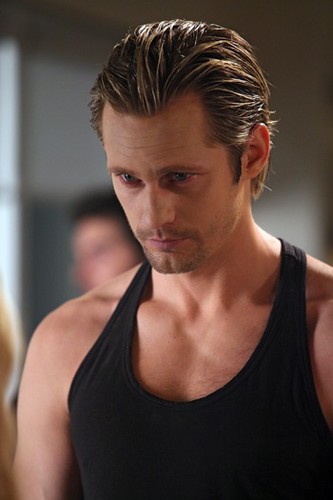

Okay, I would like this vampire to be my boyfriend. But I digress. To the review...
Dead Until Dark - Charlaine Harris
New York: Ace Books, 2001
I would never have read this were it not for True Blood. And I don't know if I would have continued watching the show - which is entertaining enough although I'm still not sure about Anna Paquin - were it not for Eric.
But I did watch the show, and got pretty into it. So clearly that meant that I had to try reading the books. My mom gave me the copies of 2-4 that she got from a friend, but I don't like starting in the middle. So I ended up buying a copy really cheap. (And now I'm babbling. Have I mentioned that Eric is hot?)
Okay. So here is Dead Until Dark. It's difficult not to compare it to the tv show. Sookie is a strange character. She can hear people's thoughts, and that creates problems for her, even as she tries to keep out of their heads. People think she is definitely weird, and possibly a little retarded. She's hot enough, but a virgin in her mid-twenties. She handles with aplomb situations that would fell me, and then gets weirded out by other things. I don't get her. And then Bill is a vampire. That's about all there is to say there.
Wow, this is a bad review. (Have I mentioned though that Eric is hot? Although not so much in this first book. Will he get more hot later on? I guess it doesn't matter as long as he stays hot on tv.) The book is enjoyable enough, and it's got some suspense and a decent mystery. I'll keep reading the series.
Thursday, July 30, 2009
I really cannot believe I read this.
The Hopeless Romantic's Handbook - Gemma Townley
New York: Ballantine, 2007
I am really enjoying Infinite Jest. A lot. But it is hard work. (Lots of testimonials to this fact over at the Infinite Summer site.) Instead of giving up, I am taking brain breaks. I have also been fighting off a cold.
All of which led to reading this. Believe me people, I KNOW. And I'm not even going to go into the story of how I came across it. What has been fun - and more fun than reading the book, which was fine, I guess - has been casting the actors in the film version. I've gotten as far as NOT Keira Knightley thankyouverymuch for Kate (maybe Natalie Dormer? or Jacinda Barrett?), Martin Freeman for Tom. I'm having more trouble with Joe, perhaps b/c I can totally picture him but can't think of the actor who is most "him." Leaning toward someone like Teddy Dunn. Anyway, I am back to the tome and on track to finish before my semester starts.
New York: Ballantine, 2007
I am really enjoying Infinite Jest. A lot. But it is hard work. (Lots of testimonials to this fact over at the Infinite Summer site.) Instead of giving up, I am taking brain breaks. I have also been fighting off a cold.
All of which led to reading this. Believe me people, I KNOW. And I'm not even going to go into the story of how I came across it. What has been fun - and more fun than reading the book, which was fine, I guess - has been casting the actors in the film version. I've gotten as far as NOT Keira Knightley thankyouverymuch for Kate (maybe Natalie Dormer? or Jacinda Barrett?), Martin Freeman for Tom. I'm having more trouble with Joe, perhaps b/c I can totally picture him but can't think of the actor who is most "him." Leaning toward someone like Teddy Dunn. Anyway, I am back to the tome and on track to finish before my semester starts.
Tuesday, July 14, 2009
Characters I Love
Memories are slippery, so I can't be sure exactly how dramatic this moment actually was, but I remember sitting, at 17, in a waiting room at Kaiser. I was there with my grandmother for some appointment or other, and I was reading War and Peace. (Isn't this how everyone spends the summer after their high school graduation?) Anyway, I had a thing for Prince Andrei. In fact, I'm looking forward to re-reading the book just so I can see how he holds up over a dozen years. And so there came a moment where another character acts in a way that will hurt him, and I exclaimed, to the whole room, "You whore!" Um, that was embarrassing.
Anyway, he's not the only character I have gotten too close to. And if you add in tv shows and movies, I am over-empathizing with characters all the time. But he's still the one that matters the most.
And now, reading Infinite Summer, I find myself (like Avery Edison) liking Hal Incandenza just a little too much. And fearing for him. Avery says anxious, and since I have such a close personal relationship with anxiety, it goes without saying that that's the best word for it. I just... I want it to be okay. But I don't think it will be.
I've always liked to root for the bad guy and tried to create antiheroes where they didn't exist. And I was down with my ex who, we joked, only liked movies where people died at the end. And yet.... A co-worker was telling me something he heard about ways in which women conceive of fairness differently than men. And really, when it comes down to it, as much as I don't want to be like everyone else, man do I crave the happy ending. I want things to be the way they are supposed to be. Which isn't always happy per se. But is the way I feel like it should be. It's unoriginal perhaps, and quite possibly is pretty unhealthy, but it's me.
All that said, I can't imagine DFW giving me what I want. And probably I'd respect him less if he did.
Anyway, he's not the only character I have gotten too close to. And if you add in tv shows and movies, I am over-empathizing with characters all the time. But he's still the one that matters the most.
And now, reading Infinite Summer, I find myself (like Avery Edison) liking Hal Incandenza just a little too much. And fearing for him. Avery says anxious, and since I have such a close personal relationship with anxiety, it goes without saying that that's the best word for it. I just... I want it to be okay. But I don't think it will be.
I've always liked to root for the bad guy and tried to create antiheroes where they didn't exist. And I was down with my ex who, we joked, only liked movies where people died at the end. And yet.... A co-worker was telling me something he heard about ways in which women conceive of fairness differently than men. And really, when it comes down to it, as much as I don't want to be like everyone else, man do I crave the happy ending. I want things to be the way they are supposed to be. Which isn't always happy per se. But is the way I feel like it should be. It's unoriginal perhaps, and quite possibly is pretty unhealthy, but it's me.
All that said, I can't imagine DFW giving me what I want. And probably I'd respect him less if he did.
Friday, April 03, 2009
It's how you play the game
Friday Night Lights - H.G. Bissinger
Cambridge, Mass.: DaCapo Press, 2004 (originally published 1990)
I've gotten attached to the tv show. After roommates and friends and some growing up, I was finally ready to appreciate a little bit of Texas. So when I heard the book was good, I bought it. And when I was searching for something different to read a couple weeks ago, I turned to it.
And then, maybe 80 pages in, I found myself in a convention center hall in Riverside. And looking out at a room full of excited youth who spent their weekend competing, having developed surprisingly strong bonds with their teammates as well as their fellow competitors. And at their parents, and coaches, who give so much of themselves to help their kids succeed. Suddenly I was not-quite-eight again, at my first feis. Or 10, in San Diego, winning my first championship. Or 14, at Nationals, when I was supposed to make the final round as a soloist and failed and when my team paid more attention to our placement compared to other California schools and so was pleased with a 6th place finish. Or 17, at my last Nationals as a competitor. My teammates... we were a family. I didn't always like all of them, and I know they felt the same. But on stage, I trusted them implicitly. I knew exactly where they would be at any given moment, without looking. I don't think you realize how unique and rare that experience is until it's over.
But back to FNL. It's about a football team, and the town the team props up. Their heroes, their goats, the ways football fits into a broader social and historical context, and the importance of being part of something bigger than yourself.
Over my time as a dancer, I learned what it was like to be the newcomer, to be the small Cinderella school. And I experienced life on top, what it was to be part of the elite school on the West Coast, expected to win. And I also felt the confusion that comes when you are supposed to win, going to win, and somehow you don't. So maybe, in my own way, I know what it's like to be a Permian Panther.
And even more so, I know what Bissinger points out that these boys learn: it doesn't last.
It had been my right once too. And maybe that's why I enjoy watching these mock trial teams trying to guess their standings by analyzing the matchups. And why I cared so much whether the Permian Panthers made it to State. And why I do care about the games that end most episodes of the tv version of Friday Night Lights. And why I want them to win, and to lose. To experience it all. Before it's the next generation's turn.
Cambridge, Mass.: DaCapo Press, 2004 (originally published 1990)
I've gotten attached to the tv show. After roommates and friends and some growing up, I was finally ready to appreciate a little bit of Texas. So when I heard the book was good, I bought it. And when I was searching for something different to read a couple weeks ago, I turned to it.
And then, maybe 80 pages in, I found myself in a convention center hall in Riverside. And looking out at a room full of excited youth who spent their weekend competing, having developed surprisingly strong bonds with their teammates as well as their fellow competitors. And at their parents, and coaches, who give so much of themselves to help their kids succeed. Suddenly I was not-quite-eight again, at my first feis. Or 10, in San Diego, winning my first championship. Or 14, at Nationals, when I was supposed to make the final round as a soloist and failed and when my team paid more attention to our placement compared to other California schools and so was pleased with a 6th place finish. Or 17, at my last Nationals as a competitor. My teammates... we were a family. I didn't always like all of them, and I know they felt the same. But on stage, I trusted them implicitly. I knew exactly where they would be at any given moment, without looking. I don't think you realize how unique and rare that experience is until it's over.
But back to FNL. It's about a football team, and the town the team props up. Their heroes, their goats, the ways football fits into a broader social and historical context, and the importance of being part of something bigger than yourself.
Over my time as a dancer, I learned what it was like to be the newcomer, to be the small Cinderella school. And I experienced life on top, what it was to be part of the elite school on the West Coast, expected to win. And I also felt the confusion that comes when you are supposed to win, going to win, and somehow you don't. So maybe, in my own way, I know what it's like to be a Permian Panther.
And even more so, I know what Bissinger points out that these boys learn: it doesn't last.
They [the former players] might come back to the locker room after a big game [...] and paw around the edges of the joyful pandemonium and it would become clear that it wasn't theirs anymore - it belonged to others who had exactly the same swagger of invincibility that once upon a time had been their exclusive right.
It had been my right once too. And maybe that's why I enjoy watching these mock trial teams trying to guess their standings by analyzing the matchups. And why I cared so much whether the Permian Panthers made it to State. And why I do care about the games that end most episodes of the tv version of Friday Night Lights. And why I want them to win, and to lose. To experience it all. Before it's the next generation's turn.
Subscribe to:
Posts (Atom)
