A weekly series where I comment on a book that I read before the launch of the Library
The inaugural feature, chosen semi-randomly (I ran my hand down the bookshelf) is Remembering Mr. Shawn's New Yorker, by Ved Mehta, a long-time staff-writer at the magazine. It's a memoir of his years writing for Mr. Shawn, and an ode to Shawn's career as an editor.
I read this book a year of so after becoming enamored with the New Yorker, and its rhapsodizing tone suited my admiration. But even at the time I recognized it was a little much. Shawn wasn't superhuman. (btw, Shawn is also known for being the father of Wallace Shawn, who played Vizzini in Princess Bride)
What I liked best about this book was the detailed description of how an article makes its way from germ of idea to the pages of the magazine. And the characters that peopled the magazine during the era.
In all, a charming read :)
Monday, November 20, 2006

Saturday, November 18, 2006
A little bit of whimsy
I finished Literacy and Longing in L.A. this afternoon. I stick with my previous statement that it was a bit of a letdown. But still sweet. Dora may be shallow, but she is also giving. And the ending, while unsatisfyingly written, is at least satisfying in terms of plot.
One thing I loved was the occasional reference to landmarks that are part of my LA as well. Like Dutton's. Although it's called McKenzie's, the central bookstore is unmistakable. It was nice to see such a haven for books get a starring role in a novel.
On a different note, I saw The Science of Sleep tonight. Michel Gondry, who wrote and directed, is an odd one. His protagonist, Stephane, can barely tell the difference between sleep and wakefulness, and therefore often neither can we. But the love story between him and his neighbor, Stephanie, is both quirky and heartwarming. It's only in his dreams that Stephanie reassures him that they are on the right track. When awake, things never seem to go quite as well. And yet you believe it is the sleeping Stephane and Stephanie that represent the true nature of their relationship.
One thing I loved was the occasional reference to landmarks that are part of my LA as well. Like Dutton's. Although it's called McKenzie's, the central bookstore is unmistakable. It was nice to see such a haven for books get a starring role in a novel.
On a different note, I saw The Science of Sleep tonight. Michel Gondry, who wrote and directed, is an odd one. His protagonist, Stephane, can barely tell the difference between sleep and wakefulness, and therefore often neither can we. But the love story between him and his neighbor, Stephanie, is both quirky and heartwarming. It's only in his dreams that Stephanie reassures him that they are on the right track. When awake, things never seem to go quite as well. And yet you believe it is the sleeping Stephane and Stephanie that represent the true nature of their relationship.
Thursday, November 16, 2006
The Westside Crazy Book Lady
No, that's not me. I still live in Hollywood, so I'm safe for now. But I'm reading Literacy and Longing in LA, a joint project by two Angelenas (is that a real term?). It's about a woman who is having a life crisis, and handles all crises by locking herself up and reading voraciously.
Much of this I can identify with. But I have to admit that I'm a little disappointed with the book so far. Dora, the protagonist, seems a little flaky, even if she is intelligent. And it's hard to believe her when she bemoans the shallowness of the Brentwood/West LA population when you discover that she lives (at 35) on a trust fund, thinks her size 12 sister seems fat (for LA, admittedly), and spends her days flitting around book stores and spying on her estranged husband.
But it IS white Los Angeles, so what is objectively shallow seems to make perfect sense within the context. I guess I just expected to identify with her more, and I'm finding that I don't want to be like her. (Although I wouldn't mind having a trust fund.)
The novel will probably grow on me. Expect a more positive review coming soon.
Much of this I can identify with. But I have to admit that I'm a little disappointed with the book so far. Dora, the protagonist, seems a little flaky, even if she is intelligent. And it's hard to believe her when she bemoans the shallowness of the Brentwood/West LA population when you discover that she lives (at 35) on a trust fund, thinks her size 12 sister seems fat (for LA, admittedly), and spends her days flitting around book stores and spying on her estranged husband.
But it IS white Los Angeles, so what is objectively shallow seems to make perfect sense within the context. I guess I just expected to identify with her more, and I'm finding that I don't want to be like her. (Although I wouldn't mind having a trust fund.)
The novel will probably grow on me. Expect a more positive review coming soon.
Monday, November 13, 2006
Plan B for the Earth - and why it needs to happen now
I have been sloooowly reading Lester R. Brown's Plan B 2.0: Rescuing a Planet Under Stress and a Civilization in Trouble. I wish it hadn't been such slow going, but lots of technical details (and repetition) have a soporific effect on me. In the end, I was pretty much reading it like an academic text - pulling out information rather than really digesting each sentence. It's the kind of book you want around as a reference, full of facts and figures and lots of suggestions.
Brown is president of the Earth Policy Institute, and he is writing to attempt to save the Earth from collapse. Our use of resources is unsustainable, and even so, far too much of the planet's population lives in poverty. So Plan B is two-fold: poverty-alleviation and "earth restoration." The annual price tag for the two: $161 billion. Sounds steep, until you realize that the United States spends more than three times that much on defense each year. And we know that some of that money is being wasted. So the money is there (and in lots of other places too, for those of you Defense Dept. boosters).
While reading, I vacillated between optimism and despair. We are in bad, bad shape. And my mind still boggles: what on earth were we thinking that oil - a fossil fuel that takes eons to form - would just never run out?! Or trees? Or topsoil? But on the other hand, lots of places are doing amazing things. Sweden and Germany have reformulated their tax systems to better reflect the costs of unsustainable activities. Bogota has dramatically dropped crime while making the city more pedestrian-friendly. New technologies have so much potential for sustainable energy, water, and more - and will create new jobs at the same time.
But it's a big, overwhelming task. We need to take it seriously. As Brown puts it, "We have won a lot of local battles, but we are losing the war." It's winnable. And we have to win.
Brown is president of the Earth Policy Institute, and he is writing to attempt to save the Earth from collapse. Our use of resources is unsustainable, and even so, far too much of the planet's population lives in poverty. So Plan B is two-fold: poverty-alleviation and "earth restoration." The annual price tag for the two: $161 billion. Sounds steep, until you realize that the United States spends more than three times that much on defense each year. And we know that some of that money is being wasted. So the money is there (and in lots of other places too, for those of you Defense Dept. boosters).
While reading, I vacillated between optimism and despair. We are in bad, bad shape. And my mind still boggles: what on earth were we thinking that oil - a fossil fuel that takes eons to form - would just never run out?! Or trees? Or topsoil? But on the other hand, lots of places are doing amazing things. Sweden and Germany have reformulated their tax systems to better reflect the costs of unsustainable activities. Bogota has dramatically dropped crime while making the city more pedestrian-friendly. New technologies have so much potential for sustainable energy, water, and more - and will create new jobs at the same time.
But it's a big, overwhelming task. We need to take it seriously. As Brown puts it, "We have won a lot of local battles, but we are losing the war." It's winnable. And we have to win.
Tuesday, November 07, 2006
ELECTION DAY!!!
I can't concentrate at all. I don't know what I was thinking coming to work (you know, making sure future generations are civically engaged) instead of going to be a poll monitor like everyone else I know.
What would help, of course, is if I could get away from the computer and my desk and read a good book :)
And speaking of good books, I just finished one: California Uncovered, a 2005 collection of stories from Californian authors. Many of the selections are excerpts from novels, and quite a few made me curious about the larger work itself. [When I get home, I will update with some examples.] One of the editors is Chitra Banerjee Divakaruni, who I have liked very much since I was in college. (I've seen her at readings too - she is lovely in person.)
On the other hand are bad stories, and that is what I've been writing (see my post below). I do not think I'm cut out to be a novelist. I tried for 2 days, and had my "novel" go in about 60 different directions. I haven't given up entirely, but I'm not convinced I should write as a chore, when I can just read something instead.
Vote, vote, vote! I love Election Day. Even if I usually don't have much to cheer about.
Update: The following were my favorites
Yxta Maya Murray (from The Conquest)
Paul Beatty (from The White Boy Shuffle)
Brian Ascalon Roley (from American Son)
Khaled Hosseini (from The Kite Runner)
Dana Johnson ("Melvin in the Sixth Grade")
Chitra Banerjee Divakaruni ("Mrs. Dutta Writes a Letter")
What would help, of course, is if I could get away from the computer and my desk and read a good book :)
And speaking of good books, I just finished one: California Uncovered, a 2005 collection of stories from Californian authors. Many of the selections are excerpts from novels, and quite a few made me curious about the larger work itself. [When I get home, I will update with some examples.] One of the editors is Chitra Banerjee Divakaruni, who I have liked very much since I was in college. (I've seen her at readings too - she is lovely in person.)
On the other hand are bad stories, and that is what I've been writing (see my post below). I do not think I'm cut out to be a novelist. I tried for 2 days, and had my "novel" go in about 60 different directions. I haven't given up entirely, but I'm not convinced I should write as a chore, when I can just read something instead.
Vote, vote, vote! I love Election Day. Even if I usually don't have much to cheer about.
Update: The following were my favorites
Yxta Maya Murray (from The Conquest)
Paul Beatty (from The White Boy Shuffle)
Brian Ascalon Roley (from American Son)
Khaled Hosseini (from The Kite Runner)
Dana Johnson ("Melvin in the Sixth Grade")
Chitra Banerjee Divakaruni ("Mrs. Dutta Writes a Letter")
Wednesday, November 01, 2006
Erin's Library to Climb a Mountain
Or rather, write a novel or something in the month of November.
One of the many non-books that I read is the blog LAist. Thanks to the power of its team of bloggers, I have learned about National Novel Writing Month (NaNoWriMo to the cool kids). As far as I can tell (their site is sloooooow today), the NaNoWriMo folk are dedicated to proving that all you need to write a novel is a little push. Their push: 50,000 words in the 30 days of November. Along with tens of thousands of your closest friends. And they even forewarn that it'll be crap. At least, most of it. But if you're me, and you like to write but don't make the time (and don't actually have a fiction story flitting around in your conscious brain), it's a pretty cool deal. So I am in the process of signing up (like I said, the site is slow) right now.
Another driving factor: I like things you can count. I am very tangible in the way I look for results. September was 10,000 steps a day + and I took great joy in calculating the change in my average performance from week to week. (I added the equivalent of an 8th day/week of walking by the end of the month.) October was sit-up and arm weight month, with similarly numerical planned gains. It got boring around the 24th. So I was trying this morning to figure out what November would be. And what better challenge than something I would never do on my own, with word/day goals, and no exercise required :) So here I go. If the novel gets far enough to acquire a title, I'll let y'all know.
One of the many non-books that I read is the blog LAist. Thanks to the power of its team of bloggers, I have learned about National Novel Writing Month (NaNoWriMo to the cool kids). As far as I can tell (their site is sloooooow today), the NaNoWriMo folk are dedicated to proving that all you need to write a novel is a little push. Their push: 50,000 words in the 30 days of November. Along with tens of thousands of your closest friends. And they even forewarn that it'll be crap. At least, most of it. But if you're me, and you like to write but don't make the time (and don't actually have a fiction story flitting around in your conscious brain), it's a pretty cool deal. So I am in the process of signing up (like I said, the site is slow) right now.
Another driving factor: I like things you can count. I am very tangible in the way I look for results. September was 10,000 steps a day + and I took great joy in calculating the change in my average performance from week to week. (I added the equivalent of an 8th day/week of walking by the end of the month.) October was sit-up and arm weight month, with similarly numerical planned gains. It got boring around the 24th. So I was trying this morning to figure out what November would be. And what better challenge than something I would never do on my own, with word/day goals, and no exercise required :) So here I go. If the novel gets far enough to acquire a title, I'll let y'all know.
Tuesday, October 24, 2006
Writers who read and readers who write
On my commute home, I listened to Francine Prose talk about her book Reading Like a Writer: A Guide for People Who Love Books and for Those Who Want to Write Them on KQED's radio show Forum. (What decade do you think host Michael Krasny's photo is from?)
I was a big fan of her latest novel, A Changed Man, so was curious to hear what she had to say about the craft of writing. And listening to a writer who loves books (see also Jane Smiley) talk about books is lovely. So it made up for the fact that my bus was late and then stalled, stretching the commute out to the full hour.
Prose has a list of 100+ "Books to Read Immediately" at the back of her book, so you know I'll be checking that out.
Also moving back up my list: Carolyn See's Making a Literary Life: Advice for Writers and Other Dreamers, a book that has languished because I never feel quite "ready" for it.
I was a big fan of her latest novel, A Changed Man, so was curious to hear what she had to say about the craft of writing. And listening to a writer who loves books (see also Jane Smiley) talk about books is lovely. So it made up for the fact that my bus was late and then stalled, stretching the commute out to the full hour.
Prose has a list of 100+ "Books to Read Immediately" at the back of her book, so you know I'll be checking that out.
Also moving back up my list: Carolyn See's Making a Literary Life: Advice for Writers and Other Dreamers, a book that has languished because I never feel quite "ready" for it.
Book Awards, So Cal style (and other updates)
A reunion, a car accident, and a cold later....
Erin is back with reading updates.
I re-read Jane Austen's Persuasion last week (for the book club). I think Anne Elliott is a mysterious character: not as vivacious as Elizabeth Bennet or Emma Woodhouse, but not as much of a mouse as Fanny Price. She remains, yet, a bit of a cipher in relation to the strong personalities around her. But Austen remains as witty, and comfortable, and biting, and evocative as ever.
Another book that's been on my list won at the 2006 Southern California Booksellers Association awards: Literacy and Longing in L.A., by Jennifer Kaufman and Karen Mack. It's supposed to be readerly chick lit, and I'm looking forward to it as a light escape and a reminder that other people in this city are also obsessed with books.
Erin is back with reading updates.
I re-read Jane Austen's Persuasion last week (for the book club). I think Anne Elliott is a mysterious character: not as vivacious as Elizabeth Bennet or Emma Woodhouse, but not as much of a mouse as Fanny Price. She remains, yet, a bit of a cipher in relation to the strong personalities around her. But Austen remains as witty, and comfortable, and biting, and evocative as ever.
Another book that's been on my list won at the 2006 Southern California Booksellers Association awards: Literacy and Longing in L.A., by Jennifer Kaufman and Karen Mack. It's supposed to be readerly chick lit, and I'm looking forward to it as a light escape and a reminder that other people in this city are also obsessed with books.
Thursday, October 12, 2006
Yay!!!
I'm on my way to my college reunion, but first:
Orhan Pamuk has won the Nobel Prize in Literature
The NY Times article lede:
And the Swedish Academy:
More thoughts coming soon...
Orhan Pamuk has won the Nobel Prize in Literature
The NY Times article lede:
Turkish novelist Orhan Pamuk, whose uncommon lyrical gifts and uncompromising politics have brought him acclaim worldwide and prosecution at home, won the Nobel literature prize Thursday for his works dealing with the symbols of clashing cultures.
And the Swedish Academy:
in the quest for the melancholic soul of his native city [Pamuk] has discovered new symbols for the clash and interlacing of cultures.
More thoughts coming soon...
Wednesday, October 11, 2006
Post-nuclear dystopias
Right in time for North Korea to go nuclear, I finished reading Tatyana Tolstaya's The Slynx, a tale of a future Moscow after the Blast. While some have survived (and gained virtual immortality) to remember the good old days, most know only this world: primitive and strange. Everyone has a Consequence from the radiation, ranging from extra limbs to feathers (and more).
I don't want to say too much about it, because it's going to be a future selection in our Russian literature book club. But it's a fascinating satire of Soviet Russia, as well as a deeply disturbing portrait of the Russians' historical tendency toward cults of personality.
On another note, books play a huge role in the novel, as the main character becomes obsessed with reading:
I don't want to say too much about it, because it's going to be a future selection in our Russian literature book club. But it's a fascinating satire of Soviet Russia, as well as a deeply disturbing portrait of the Russians' historical tendency toward cults of personality.
On another note, books play a huge role in the novel, as the main character becomes obsessed with reading:
I only wanted books - nothing more - only books, only words, it was never anything but words - give them to me, I don't have any!It's terrifying to imagine - what if there was nothing left to read?! Luckily, that's unlikely to ever be a problem for me! :)
Wednesday, October 04, 2006
Trouble in Education
It has been a busy time at the Library. Catching up on some reading, and checking out some books for an upcoming book club. (Anyone interested in a 6 novel "history of Russian literature" group?) And also lots of work.
But on a guilty pleasure trip to the library on Saturday (I wanted a romance novel - it shall not be reviewed here, as I've already revealed too much about an occasional weakness), I finally broke down and checked out my first audio book.
I went with Jonathan Kozol's The Shame of the Nation: The Restoration of Apartheid Schooling in America, which had been hovering at the edges of my book list. Kozol has been writing for some time about how public schooling is failing American children; this is a pretty damning indictment of our self-congratulation of Brown v. Board of Ed while letting the schools reossify into middle-class white and lower-class of color. And lest you think this is "separate but equal," curricula and even recess are entirely different matters. And how disgusting is the administrators' euphemism "diverse" for schools that are anything but, over 90% African-American. That's not diversity, it's just not whiteness.
This is a touchy subject for me, as I've wondered what I would do if I were raising my own future children in Los Angeles. I don't think most of the schools are good enough for my children; yet I believe very strongly that more middle-class families have to keep their children in struggling school systems, and work to lift them up. On a more pressing timeline, the Munchkins (aged 7 and 4) are currently attending/will attend a public elementary school, but will they have to go private or charter by junior high?
Also troubling is the relentless emphasis on teaching to the test that Kozol finds in these schools. I have never ever liked standardized testing, although in retrospect it was pretty cool to spend school time on an activity I knew I'd do well on. But precisely because I was the queen of the multiple choice exam, I never believed that it could say all that much about how smart you were. Isn't real learning and intelligence about more than that? And hearing how much time is spent on testing instead of science, history, music, PE, or the silly activities that make school fun made me so mad that I fumed down the street.
Which reminds me... I was listening to the book while walking down the street. I loaded the cds onto iTunes, and from iTunes to my iPod, and was good to go. It's definitely strange to listen to a book, but I think as it goes, nonfiction is the way to break into it. It's all written in one voice - the author's - anyway, and so it feels sort of like a lecture. It a nice way to commute (and also works for grocery shopping).
But on a guilty pleasure trip to the library on Saturday (I wanted a romance novel - it shall not be reviewed here, as I've already revealed too much about an occasional weakness), I finally broke down and checked out my first audio book.
I went with Jonathan Kozol's The Shame of the Nation: The Restoration of Apartheid Schooling in America, which had been hovering at the edges of my book list. Kozol has been writing for some time about how public schooling is failing American children; this is a pretty damning indictment of our self-congratulation of Brown v. Board of Ed while letting the schools reossify into middle-class white and lower-class of color. And lest you think this is "separate but equal," curricula and even recess are entirely different matters. And how disgusting is the administrators' euphemism "diverse" for schools that are anything but, over 90% African-American. That's not diversity, it's just not whiteness.
This is a touchy subject for me, as I've wondered what I would do if I were raising my own future children in Los Angeles. I don't think most of the schools are good enough for my children; yet I believe very strongly that more middle-class families have to keep their children in struggling school systems, and work to lift them up. On a more pressing timeline, the Munchkins (aged 7 and 4) are currently attending/will attend a public elementary school, but will they have to go private or charter by junior high?
Also troubling is the relentless emphasis on teaching to the test that Kozol finds in these schools. I have never ever liked standardized testing, although in retrospect it was pretty cool to spend school time on an activity I knew I'd do well on. But precisely because I was the queen of the multiple choice exam, I never believed that it could say all that much about how smart you were. Isn't real learning and intelligence about more than that? And hearing how much time is spent on testing instead of science, history, music, PE, or the silly activities that make school fun made me so mad that I fumed down the street.
Which reminds me... I was listening to the book while walking down the street. I loaded the cds onto iTunes, and from iTunes to my iPod, and was good to go. It's definitely strange to listen to a book, but I think as it goes, nonfiction is the way to break into it. It's all written in one voice - the author's - anyway, and so it feels sort of like a lecture. It a nice way to commute (and also works for grocery shopping).
Sunday, September 24, 2006
Vote! (or else I'll footnote you to death)
Among other things in recent days, I've been reading Consider the Lobster, David Foster Wallace's collection of essays about random cultural phenomena that he has been contracted by some magazine or another to write about. He's an interesting guy - I'd like to know a little more about him. (Probably googling or wiki-ing him would work. If only I weren't too lazy to do that before writing this...)
Anyway, DFW has a reputation for being ridiculously smart and for loving the footnotes. As a tangential, full-of-asides thinker, I like this. But I still think it's a gimmick. Plus, it sometimes works better than others. In "Big Red Son," the footnotes are hilariously juxtaposed against the topic, which is porn. In "Host," the footnotes are actually placed within boxes within the body of the text, with arrows from the referring point (and sometimes more arrows to fn's about fn's, etc.) Visually kinda cool. The Dostoyevsky article, on the other hand, is too academic for footnotes, even if it seems ironic to write that. And "Up, Simba," a 2000 Rolling Stone profile of John McCain, would completely flounder if it had footnotes at all.
Which reminds me, "Up, Simba" is perhaps the most interesting article of the bunch. (Speaking as a historian.) It's an amazing reminder of how quickly political history can move. McCain's primary opponent is "the Shrub" and the journalists are in thrall to their cell phones (with pull-out antennae) and the occasional Palm Pilot. Imagine political wonks now without their Blackberries. And DFW's commentary on voter apathy and politician sincerity and the staged artifice of the whole campaign trail is like crack for this post-West Wing viewer. And since political engagement is near and dear to my heart, I was particularly impressed by this passage:
And this is backed up by all sorts of anecdotal evidence, btw. Anyway, I'm planning to use this argument whenever I can. It's the kind of thing that you know on some level, but sometimes need spelled out for you. At least I think so.
I'm going to put Infinite Jest, DFW's novel, on my reading list. I need the extra information to determine what exactly I think of this hyper-erudite writer.
Anyway, DFW has a reputation for being ridiculously smart and for loving the footnotes. As a tangential, full-of-asides thinker, I like this. But I still think it's a gimmick. Plus, it sometimes works better than others. In "Big Red Son," the footnotes are hilariously juxtaposed against the topic, which is porn. In "Host," the footnotes are actually placed within boxes within the body of the text, with arrows from the referring point (and sometimes more arrows to fn's about fn's, etc.) Visually kinda cool. The Dostoyevsky article, on the other hand, is too academic for footnotes, even if it seems ironic to write that. And "Up, Simba," a 2000 Rolling Stone profile of John McCain, would completely flounder if it had footnotes at all.
Which reminds me, "Up, Simba" is perhaps the most interesting article of the bunch. (Speaking as a historian.) It's an amazing reminder of how quickly political history can move. McCain's primary opponent is "the Shrub" and the journalists are in thrall to their cell phones (with pull-out antennae) and the occasional Palm Pilot. Imagine political wonks now without their Blackberries. And DFW's commentary on voter apathy and politician sincerity and the staged artifice of the whole campaign trail is like crack for this post-West Wing viewer. And since political engagement is near and dear to my heart, I was particularly impressed by this passage:
If you are bored and disgusted by politics and don't bother to vote, you are in effect voting for the entrenched Establishments of the two major parties, who please rest assured are not dumb, and who are keenly aware that it is in their interests to keep you disgusted and bored and cynical and to give you every possible psychological reason to stay at home doing one-hitters and watching MTV on primary [replacable with Election - ed.] day. By all means stay home if you want, but don't bullshit yourself that you're not voting. In reality, there is no such thing as not voting: you either vote by voting, or you vote by staying home and tacitly doubling the value of some Diehard's vote.
And this is backed up by all sorts of anecdotal evidence, btw. Anyway, I'm planning to use this argument whenever I can. It's the kind of thing that you know on some level, but sometimes need spelled out for you. At least I think so.
I'm going to put Infinite Jest, DFW's novel, on my reading list. I need the extra information to determine what exactly I think of this hyper-erudite writer.
Sunday, September 17, 2006
Not the most uplifting of reading...
I finished Disgrace (J.M. Coetzee) sometime in the last week or so. I haven't written about it mainly because I wasn't sure what to say. Sometime, with the book club selections, it seems to work best to blog my review after the meeting, and incorporate others' views into my own coalesced opinion.
But I got bored of waiting. This novel is filled with disturbing events and internal reveries. In this respect, it reflects - sometimes overtly, sometimes implicitly - the confusion and readjustment of whites (even liberal ones) to the post-apartheid world. Sex is potent as a symbol of asserting manliness and power - as a weapon, a reassurance of attraction, etc. It reminded me a lot of Philip Roth in this respect. (I'm not very convinced that male authors like women very much. Are they representative of the average man's secret fears? I'd prefer to think not.) But there is also a generational dispute between the male pro(?)tagonist and his daughter. Like in Fathers and Sons (thanks to Michael and a review he found for the comparison), in a time of change and confusion, the eternal struggle between parents and children is freighted with extra meaning.
But attempts of erudition aside, what was most striking about Disgrace was how much of it I spent wanting to cover my eyes, urging the main character "What are you thinking?! - Stop." It's not that much fun, and I'm not totally convinced that it deserved the Booker.
For all my ambivalence, however, Disgrace is a far more accomplished novel than the one I just finished: Intuition, by Allegra Goodman. It made it onto my reading list after a promising review earlier this year. Set in a research lab in the mid-80s, Intuition addresses the ups and downs of scientific research and the intuitions (hence the title) that lead people to monomaniacal obsession with proving their instincts correct. In the end, intuition can ruin relationships.
Intuition is a fascinating topic for a book on scientific inquiry, a field that is supposedly ruled by reason and empirical evidence. And Goodman starts out with a fast pace, drawing interesting characters and setting up several intriguing story arcs. But around half-way through, it fizzles out, and the last hundred or more pages was just a slog to the finish. I also wondered why Goodman set the novel in Boston of 1986 rather than today - it was never clear to me why an era two decades past was crucial to her story.
So both books are pretty much downers, and while I wouldn't go so far as to say I disliked either, neither managed to capture my imagination for very long.
But I got bored of waiting. This novel is filled with disturbing events and internal reveries. In this respect, it reflects - sometimes overtly, sometimes implicitly - the confusion and readjustment of whites (even liberal ones) to the post-apartheid world. Sex is potent as a symbol of asserting manliness and power - as a weapon, a reassurance of attraction, etc. It reminded me a lot of Philip Roth in this respect. (I'm not very convinced that male authors like women very much. Are they representative of the average man's secret fears? I'd prefer to think not.) But there is also a generational dispute between the male pro(?)tagonist and his daughter. Like in Fathers and Sons (thanks to Michael and a review he found for the comparison), in a time of change and confusion, the eternal struggle between parents and children is freighted with extra meaning.
But attempts of erudition aside, what was most striking about Disgrace was how much of it I spent wanting to cover my eyes, urging the main character "What are you thinking?! - Stop." It's not that much fun, and I'm not totally convinced that it deserved the Booker.
For all my ambivalence, however, Disgrace is a far more accomplished novel than the one I just finished: Intuition, by Allegra Goodman. It made it onto my reading list after a promising review earlier this year. Set in a research lab in the mid-80s, Intuition addresses the ups and downs of scientific research and the intuitions (hence the title) that lead people to monomaniacal obsession with proving their instincts correct. In the end, intuition can ruin relationships.
Intuition is a fascinating topic for a book on scientific inquiry, a field that is supposedly ruled by reason and empirical evidence. And Goodman starts out with a fast pace, drawing interesting characters and setting up several intriguing story arcs. But around half-way through, it fizzles out, and the last hundred or more pages was just a slog to the finish. I also wondered why Goodman set the novel in Boston of 1986 rather than today - it was never clear to me why an era two decades past was crucial to her story.
So both books are pretty much downers, and while I wouldn't go so far as to say I disliked either, neither managed to capture my imagination for very long.
Monday, September 11, 2006
Cricket - c.1989-2006
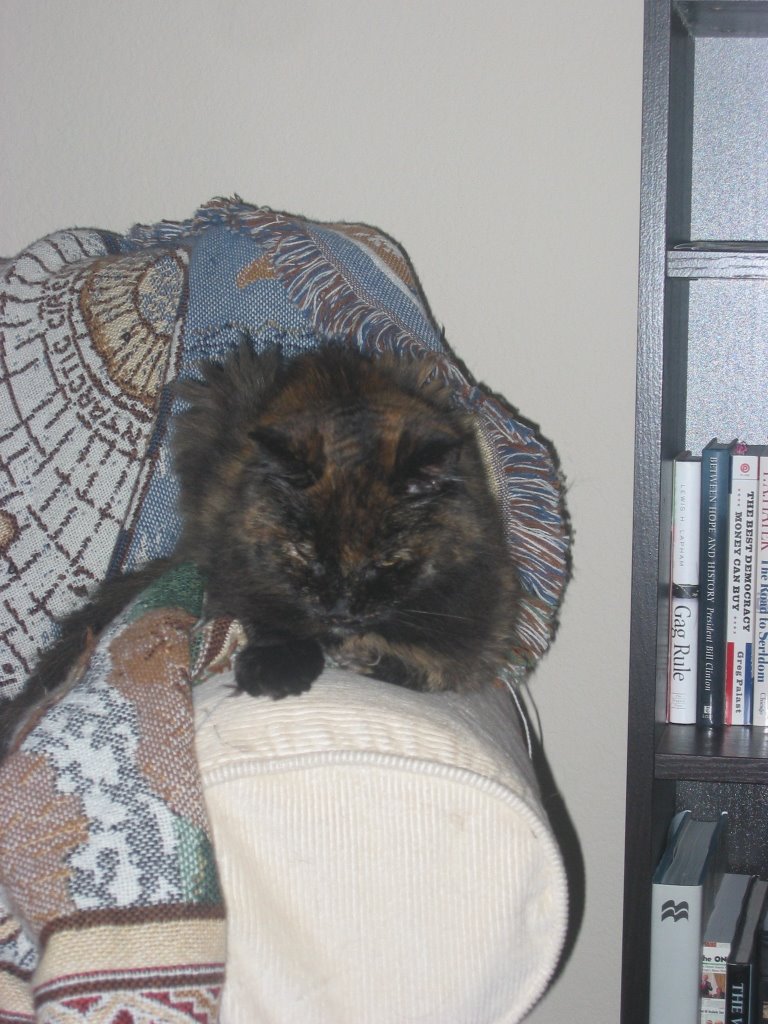 this is my fuzzy little princess, seen last Christmas
On a day tailormade for memorials, it saddens me to add to the bunch Cricket, my (parents') tortoiseshell who was terrified of just about everything, and a little bit bitchy, but all in all a very sweet little cat.
She became part of our household in July 1995; she came into the animal shelter in a carrier while we were there and settled into my mother's arms before ever going into a shelter cage. And though she hid for the first few days in our house, and was later pestered by her rambunctious fellow kitty Mikey, she settled in. We named her Cricket after the squeaky noise she made, although she came to whine imperiously more than squeak. And even though she had been ailing for quite some time, it is still a shock to lose her.
Lest you be thinking this is unrelated to books, Cricket used to like to lie on my back or the back of my legs if I was reading on my stomach. (Each of my cats has had a different way of reading with me. Pushy used to like to curl up under my chin and drool on the pages; Mikey would prefer to swish his tail in front of my face so that I couldn't see.)
Farewell Cricket. We've loved you very much.
She became part of our household in July 1995; she came into the animal shelter in a carrier while we were there and settled into my mother's arms before ever going into a shelter cage. And though she hid for the first few days in our house, and was later pestered by her rambunctious fellow kitty Mikey, she settled in. We named her Cricket after the squeaky noise she made, although she came to whine imperiously more than squeak. And even though she had been ailing for quite some time, it is still a shock to lose her.
Lest you be thinking this is unrelated to books, Cricket used to like to lie on my back or the back of my legs if I was reading on my stomach. (Each of my cats has had a different way of reading with me. Pushy used to like to curl up under my chin and drool on the pages; Mikey would prefer to swish his tail in front of my face so that I couldn't see.)
Farewell Cricket. We've loved you very much.
Wednesday, September 06, 2006
Meme, or, How I Learned a New Word Today
Until this afternoon, meme was one of those words (like trope and singularity had once been) that I vaguely knew but mostly dismissed as pretention. Until I got tagged by greenLAgirl, accused of falling for a pyramid scheme by Michael, and figured it was time I got an official definition. Hooray for Dictionary.com which built on Michael's expanded definition of "chain letter/thought virus" and explained that a meme was from same Latin root as "mime" and is "a unit of cultural information, such as a cultural practice or idea, that is transmitted verbally or by repeated action from one mind to another." Like a gene, except of ideas.
Anyway, but I believe I was tagged to talk about my literary tastes, not my fondness for etymology. So, without further ado:
A book that changed my life
The Fall of a Sparrow, by Robert Hellenga. Friends have challenged this one, but I read it at the exactly the right moment, in the right place.
A book I’ve read more than once
Emma, by Jane Austen. Possibly my all-time favorite book.
A book I’d take with me if I were stuck on a desert island
I am leaning toward Tolstoy, and War and Peace for the epic sweep. But I would also consider The Bible (King James), since I haven't read much of it and I'd have the time to consider a lot of stories.
A book that made me laugh
Anything by Helen Fielding - I am particularly fond of two that I know made me laugh aloud in public: Cause Celeb and Olivia Joules and the Overactive Imagination
A book that made me cry
A Prayer for Owen Meany, by John Irving. That book tore me apart inside.
A book that I wish had been written
My dissertation? It was going to be on life behind the lines (i.e. where they sent all the promising students and most of the government) in Soviet Union during WWII.
A book that I wish had never been written
So many books have inspired hatred and violence - I could choose one of them. But I won't, because I don't seem to be able to find it in me to wish a book unwritten.
A book I’ve been meaning to read
I've had Herodotus' Histories on the backburner since I got through half of it the first week of my graduate program. Also at least 30 others.
I’m currently reading
In addition to my pile of New Yorkers, I have begun Disgrace, by J.M. Coetzee.
Mr. Library (better known to some as the voice behind Vibes Watch) has graciously consented to be tagged. And I am realizing that my blogroll is pretty limited. So.... help me build it up, yo. I recognize that Rahul is probably above this, but just in case, I'll try tagging him too. As well as HH, whose i8 I just discovered. Will you come to LA and cook for me?
Anyway, but I believe I was tagged to talk about my literary tastes, not my fondness for etymology. So, without further ado:
A book that changed my life
The Fall of a Sparrow, by Robert Hellenga. Friends have challenged this one, but I read it at the exactly the right moment, in the right place.
A book I’ve read more than once
Emma, by Jane Austen. Possibly my all-time favorite book.
A book I’d take with me if I were stuck on a desert island
I am leaning toward Tolstoy, and War and Peace for the epic sweep. But I would also consider The Bible (King James), since I haven't read much of it and I'd have the time to consider a lot of stories.
A book that made me laugh
Anything by Helen Fielding - I am particularly fond of two that I know made me laugh aloud in public: Cause Celeb and Olivia Joules and the Overactive Imagination
A book that made me cry
A Prayer for Owen Meany, by John Irving. That book tore me apart inside.
A book that I wish had been written
My dissertation? It was going to be on life behind the lines (i.e. where they sent all the promising students and most of the government) in Soviet Union during WWII.
A book that I wish had never been written
So many books have inspired hatred and violence - I could choose one of them. But I won't, because I don't seem to be able to find it in me to wish a book unwritten.
A book I’ve been meaning to read
I've had Herodotus' Histories on the backburner since I got through half of it the first week of my graduate program. Also at least 30 others.
I’m currently reading
In addition to my pile of New Yorkers, I have begun Disgrace, by J.M. Coetzee.
Mr. Library (better known to some as the voice behind Vibes Watch) has graciously consented to be tagged. And I am realizing that my blogroll is pretty limited. So.... help me build it up, yo. I recognize that Rahul is probably above this, but just in case, I'll try tagging him too. As well as HH, whose i8 I just discovered. Will you come to LA and cook for me?
Subscribe to:
Posts (Atom)
