Thursday, December 30, 2010

2010 WrapUp & Best Of...

I read a lot at the beginning of this year. And then life got really hectic and I stopped reading. As much as I ever "stop" reading. Anyway, so my total count for the year is somewhere in the neighborhood of 42 books. (This does not include romance novels, which I should finally be brave and just admit that I read about 6 times/year.... Dude, they have hockey ones.... and it also counts all those Vampire Diaries titles as a single one.)

Going back and making a best of list was difficult, especially since there was a lot of light reading that I really enjoyed. And then there was a Pulitzer Prize-winner that didn't crack the list either. But whatever.... it is what it is, to bring back a phrase that was finally starting to fade out of my vocabulary.

But here it is, starting with some not-quite-official selections...

*Wolf Hall - Hilary Mantel - technically I finished this last Dec. 31, but it never had a chance to count on my books of 2009, so here it is. Lovely.
*War and Peace - Leo Tolstoy (trans. by Richard Pevear & Larissa Volokhonsky) (Alfred A. Knopf, 2007) - well, obviously. This one also gets an asterisk because I had read the novel before. But not this translation!

And the rest, in reverse chronological order from when I read them:

The Hunger Games Trilogy - Suzanne Collins
I hadn't realized that YA dystopias could be so moving

North and South - Elizabeth Gaskell
Won't knock Austen off her throne, but such a joy to discover.

One Day - David Nicholls
I have heard critiques that it is a little too manipulative, but screw that. I was enthralled.

Scribbling the Cat - Alexandra Fuller
This memoir was stunning. I kept finding myself dumbstruck.

The Possessed (etc.) - Elif Batuman
The title of my blog post was Russian! Books! Stanford! - 'Nuff said.

Bel Canto - Ann Patchett
So much more beautiful and moving than I had expected.

The Black Book - Orhan Pamuk
Challenging, but worth the effort.

A Fortunate Age - Joanna Smith Rakoff
I will always be a sucker for these novels about college graduates whose lives look just enough like mine.

Excellent food for thought, and a reminder of the complicated and thoughtful man who became president.

2666 - Roberto BolaƱo
Soooooo good. So interesting. So confusing. Will eventually require additional reads.

2011 resolutions upcoming.... Stay tuned.

Monday, December 27, 2010

Face of a Revolution

Mockingjay - Suzanne Collins (Scholastic Press, 2010)

After waiting 3 months between The Hunger Games and Catching Fire, I waited about 10 hours before diving into Mockingjay. I mean, what is the point in being finished with the semester if you can't do things like that?

So.

A lot of this trilogy is about the indignity of being having no control over your life, of being a pawn manipulated for the entertainment of others. Of finding ways to live with integrity in this system, of being authentically yourself. (This does seem a little like being a teenager, doesn't it?) Katniss is particularly compelling because of what I have to call - although the term is so inexact - her naivete; she is capable of genuine independent and surprising action, but within a system of other actors that continue and continue to try to use her to meet their own ends. This does not change in the third installment. In fact, if anything it gets more brutal.

This book was the saddest of the three for me. I found it difficult even as I couldn't stop reading - and it was both good and bad that while I was reading the suspenseful trip through the Capitol, J was arranging (arranging?) a three-part harmony to "Zip-a-dee-doo-dah" - the juxtaposition was creepily appropriate. But it finally ends. And while I saw a few different ways in which Collins could satisfactorily conclude, I felt like this perhaps made the most sense. It was always what I wanted, more or less.

This was some of the most fun I had reading this year. I'll be recommending it for sure.

Wednesday, December 15, 2010

Back to Panem

Catching Fire - Suzanne Collins (Scholastic Press, 2009)

For some reason that I won't try to understand, my library has far fewer copies of Catching Fire than of either The Hunger Games or Mockingjay. So - and since I was supposed to be concentrating on school anyway - I waited to request a copy, figuring that if one was free it was meant to be. Otherwise I was supposed to wait until the end of the semester.

But then I got impatient, and got on the list so that I would get the book right around the end of the semester. So as soon as I turned everything in last week, I got down to the important business of returning to Panem and finding out what was up with Katniss. (er, spoiler: she survives the Games in the first book.)

Anyway, there is more love-triangle drama. Of a decidedly tame - and thus adorable - type. Plenty of unexpected twists. And life in general there just sort of sucks. But Katniss remains this interesting, thoughtful, extraordinary young woman. And the other characters gain additional dimension this time around too.

The plot moves quickly, and I was surprised when I came to the end. Fortunately though, I had already snagged my copy of Mockingjay, so instead of waiting and reading something else, I will be finishing the trilogy this week instead...

BACK! (Also, more cheesiness)

The Awakening, The Struggle, The Fury, Dark Reunion (Vampire Diaries 1-4) - L.J. Smith (Harper Teen, 2007 - originally published 1991-2)
Nightfall andShadow Souls (Vampire Diaries - The Return 1&2) - L.J. Smith (Harper Teen, 2009 & 2010)

While I was busy being on hiatus and "not reading", I also decided that it was very important that I read a vampire book for Halloween. And then I figured I might as well read the whole series. Which is loooooong. At least the new ones. Smith, like Meyer & Harris, has let her vampire world get totally out of control. Whatever I read in Shadow Souls about demons and weird underground dimensions I still don't understand. And like Meyer, she just starts writing longer and longer books.

But they are entertaining. If you can look past all the ridiculousness and the sloppy editing, they are kind of fun. It was certainly all I was capable of taking on during the month of November.

(I like the show better though. Mainly for Damon.)

Wednesday, October 27, 2010

Going home, moving on

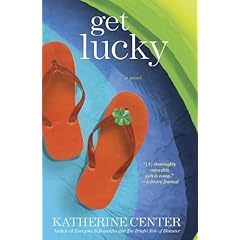
Get Lucky - Katherine Center (Ballantine Books, 2010)

You may remember that it was just a couple weeks ago that I announced I was taking a break from reading. And I really have had barely any time to read recreationally (Twitter aside).

But on the other hand, a week into my hiatus, I found myself desperately craving narrative. And even though I have a nice DVR backlog as well, I needed a book. And a book with a story. But nothing too taxing. A beach read, probably. And so that's how an advance copy of Get Lucky fell into my hands.

It's cute. The premise is that this woman returns home to Houston in order to be a surrogate mom for her sister and brother-in-law. (I immediately thought of Phoebe Buffay.) And also she is trying to figure out what to do with her life. And also the high school ex who she treated terribly back in the day is back in town... and superhot. (Also he dated Mary Louise Parker? Because of course he did.) Oh, and there's a library subplot, which is adorable. And another about how the sisters have come to terms (or not) with their mother's death when they were teens. That could have spun off into a different literary novel had Center gone in that route.

Sarah isn't particularly likable though. I mean, she's fine. But I never felt like I really got to know her. Which was a little too bad.

I love the book cover though... Flip flops! With a little shamrock! Adorable.
Get Lucky by Katherine Center

Wednesday, October 13, 2010

I want this

Ad in a recent New Yorker:


This is a Russian magazine called Snob. Obviously I must find myself a copy.

Monday, October 11, 2010

Free books!!!

I am still not reading (sigh) but I did get my hands on a free copy of Nicole Krauss's Great House. Yay. Yay yay yay!

Thursday, October 07, 2010

Hiatus...

Sigh. School is hard. And I have real hours at work. And some other things going on.

All of these are good things, but they are meaning that for now I am limited my reading to the New Yorker and bits and pieces online. I'm not sure how long this will last, but for now, this blog is likely to be quiet for the next few weeks.

Sunday, September 26, 2010

Austen was REGENCY. This is VICTORIAN.

North and South - Elizabeth Gaskell (Penguin Books, 1995 - orig. serialized 1854-55)

A month or two ago, I found out that my friend Jason was going to be speaking at an upcoming service at the church I attend. His topic? Victorian novelist Elizabeth Gaskell and her Unitarian background and the Unitarian themes in her work. My response? BOOKS. Yay!

But I had never actually heard of Gaskell, and wanted to read something by her. And then I forgot, but then his talk got postponed to today, so a couple weeks ago we had the following conversation (paraphrased):

Me: If I were to read just one Elizabeth Gaskell book before you do your thing, which should I read?
Jason: Actually, there's a really good BBC mini-series of North and South.
Me: (offended) What? You think I can't handle reading the book?!?
Jason: (in mild distress) No. It's just... well, the book is long and I don't know if you'll like it, etc.
Me: How about I actually read the book and decide for myself?
[Karen: I love this moment. The writer telling the librarian to watch the movie instead of reading the book.]

I actually understand Jason's reluctance. Recommending books is a slightly treacherous task. Especially when you find yourself recommending a book that is 150 years old and over 400 pages long. But I asked, so I took all the responsibility on myself. It would have been my own problem had I not liked it.

Except I didn't not like it. It was so good. (Today is italics day, btw.) Now that I've taken up all this space with prologue, I will be brief about the actual review. You can go read it yourself - or watch the mini-series, which I saw half of last night. (Book is more fully realized - shock! - but I will admit that Richard Armitage is totally hotter than my imaginary Mr. Thornton.)

So a few of the main things: the title refers to the collision of Northern (industrial) and Southern (more genteel and also pastoral) mores during the period. Margaret (South) and her family move to a mill town when her father gives up his vicarage as a result of his religious doubts. Margaret, as an outsider, finds much to dislike in the North (and vice versa) but grows more fond of the region and its principles through her relationships with a millworker and his dying daughter as well as a mill owner, who is also her father's pupil. There is a strike, and a violent riot, and a love story, and lots to think about philosophically. Or you can just think about the love story, which is quite a bit like Pride & Prejudice if we had actually gotten to know Mr. Darcy a little better. (Also had Elizabeth Bennet been a little less Lizzy-esque and more like the rest of Austen's heroes. But Jason has reminded me multiple times that this is more than a whole generation later, so I really ought to stop making the comparison.)

But I will say that if you like either Austen or Dickens, you will find something to like in North and South. Also, yay for the book, for Gaskell, for Jason, and for the BBC.

Tuesday, September 14, 2010

July 15

One Day - David Nicholls (Vintage Books, 2009)

One day a year.... on one day a year, starting in 1988, we check in on Dexter & Emma. That first time, they have just hooked up, right as they're graduating from college. It looks an awful lot like a one-night stand. But it's the beginning of a really powerful connection.

I'm a girl, and I've loved unrequitedly, so maybe I'm especially sensitive to how much work Emma puts into the relationship in its first years. (They actually reminded me a lot of Carley & Hunter in this book, which worried me.)

But I love the way it works. I love the development, how seeing them just once a year makes it so clear how much (and how little) they change - and how we never really end up where we think we are going.

I also starting thinking about the choice of dates. Mid-July... I can start in college, and realize that give-or-take a little, you would see a lot of me if you checked in on me then: getting on a plane for a solo trip to Italy, starting a long-term relationship that would shape me considerably, sitting on a beach wondering what on earth I was going to do now that I had a degree, feeling miserable in a job that didn't challenge me, signing the lease on my DC apartment (1999-2003). So my own life was in strange ways very close to the surface as I read, because it all felt so tangible.

You can't really talk about the plot without spoiling the whole thing. You just can't. Which is frustrating, because I really have a lot to say. I need to find someone else who has read it - hello anyone? this is a popular book based on circulation at my library, so I know you're out there - so I can vent and work through the difficult emotions. And the ways that I was prepared for a whole variety of plot twists, but unprepared perhaps precisely when I needed to be. I had troubled dreams last night because of you, David Nicholls. I just thought you should know.

Thursday, September 09, 2010

May the odds be ever in your favor

The Hunger Games - Suzanne Collins (Scholastic Press, 2008)

Unlike with many things that get overhyped, I was not "ugh, this is going to be overhyped," I was actually ready and eager to really enjoy it. (I actually felt this way about Twilight too, come to think of it, so many my natural skepticism falls away for YA materials. But talking about Twilight in a discussion of HG is unacceptable, so let me get back to the point.)

The hype is totally deserved. I was really blown away.

The prose is simple, and the plot arc is fairly predictable, but none of that really matters because Katniss has such a strong voice. The dystopic world is the right ratio of familiar and foreign, and just because you are pretty sure how the end will look doesn't mean that you won't be wrapped up in figuring out how to get there.

Oh yeah, plot. It's the future. An evil Capitol demonstrates its power over the outlying districts by forcing teens to compete against one another to the death. For the winner: glory, wealth, fame. For the 23 losers: well, duh. Katniss ends up there and the boy from her district is one with whom she has a past. And maybe a future? (By the way, if you can read this book without thinking about Bella, Edward, and Jacob, you are a stronger person than I am. But Katniss is about a zillion times more kickass than Bella, and there is no good correlation to be had among the men. At least not yet.)

Anyway, go. Read. Also, games. They are fun.

Tuesday, August 31, 2010

Finishing School 2.0

The Finishing Touches - Hester Browne (large print edition, Wheeler, 2009)

Remember how I said "No more chick lit for a while"??? Somehow this didn't stop me from leaving the library last Friday with yet another one. This one is British though, which I kind of think should be a separate category.

And I really enjoyed it. The storyline is sort of absurd: this baby is abandoned on the doorstep of a London finishing school (the morning of/before Princess Di's wedding) and raised by the lord and lady who run the place and two old maid employees. Flash forward to the present. Betsy's adoptive mother has died and Betsy returns from Scotland for the memorial service where she discovers that the school is in shambles. (Duh, b/c who goes to finishing school in 2008?) Betsy got a math degree instead of going to the school herself - she is bitter about this actually - and is recruited to save the place and her mother's legacy. High jinks ensue. [That is my standard ending for pretty much ever plot summary, if you haven't noticed.]

But here are the things that make it work: British heroines are almost always more self-aware and hilarious than their American counterparts, and the supporting cast is just better. The four students - crazy rich young women - are adorably written, and I got a kick out of how they and Betsy interacted. It was over-the-top, but it also seemed real. And the love story was well-crafted. Browne sets it up so you're like, oh, it's this cliche. And then immediately something else happens, and you're like, oh nevermind, it's this cliche. And then sends you tripping back and forth between them for quite a while. Well played.

(On a side note, I ended up with the large print edition, which made the book almost 600 pages long and more importantly often made me feel like I was reading a kids' book. I understand why a lot of people who don't need the large print refuse to read it. It probably took well over 100 pages to get used to it.)

And now, seriously, I'm going to try to take a break from the chick lit. I swear.

Friday, August 27, 2010

Wrapping Up: Peace, after War

War and Peace - Leo Tolstoy (trans. by Richard Pevear & Larissa Volokhonsky) (Alfred A. Knopf, 2007)

Volume Four & the Epilogue


How much do I love that Tolstoy writes a two-part epilogue almost 100 pages long? (Not a lot actually. It's so him, and that I love, but if I were his editor, part two of the epilogue would be long gone.)

Volume Four is mostly about what happens to the French (and Russian) armies after Napoleon occupies Moscow and then up and leaves, retreating all the way back to France, army in tatters. Tolstoy has a LOT to say about this, and about what caused the retreat, and how the Russians "won" by losing. This all can be mostly summed up here: "Only unconscious activity bears fruit, and a man who plays a role in a historical event never understands its significance. If he attempts to understand it, he is struck with fruitlessness."

This also gives him a chance to do what he seems to love best, which is to make fun of historians. He also shares his opinions on doctors, and on "intelligent" women - who are juxtaposed with "real women, endowed with the ability to select and absorb all the best of what a man has to show." (Yes, I almost threw my book across the room here.)

But you forgive Tolstoy. Because he is big and expansive, creating a whole world that is larger than life. Sometimes when I think of him, I think of Whitman.

Other things happen too. There are a few major deaths, a couple marriages. The epilogue takes us into the future and lays the groundwork for what I understand was the original plan for W&P: understanding how the Decembrists (not these guys) became the Decembrists.

I was dissatisfied with how it all worked out when I read it at 17. This time around, I get it more. It somehow seems more appropriate and right. I don't really begrudge the characters their actions anymore, although I wish I could have seen the alternate world where you'd get my happy ending. It probably wouldn't have been especially happy, after all.

And the last of the Twittering, where it's clear I lost a lot of steam:
  • Turns out that if your sister is engaged to a dude, it's not okay for you to get involved with the same dude's sister.
  • On the other hand, if then that guy were to die....
  • "The war was being conducted against all the rules (as if there existed some sort of rules for killing people)."
  • "But pure, perfect sorrow is as impossible as pure and perfect joy."

Filthy Rich Girls

The Dirty Girls Social Club - Alisa Valdes-Rodriguez (St. Martin's Press, 2003)

Perhaps I should take a break from the chick lit.

I ended up just finding this to be fairly mediocre. And then I felt bad about not enjoying it. Valdes-Rodriguez has a sunny, conversational style that was a kick, and really worked with the story. Plus I really loved the ways in which she complicates America's overly simplistic view of what it means to be Latina. What you look like, where your family comes from, what foods you eat, what languages you know. But I just felt unsatisfied. Why? you ask...

Las sucias. The girls themselves were fine, and I like how much they judge and often don't really like one another. It made their friendships and connections seem real. But seriously? There was so. much. money. They are rich, or their boyfriends/husbands/benefactors are. Or they're not, but then they become Shakira or something. Too much wealth. I know this is a problem with all chick lit, but it's somehow amplified when you have six main characters.

Speaking of six main characters... this meant I never really got to know any of them as well as I wanted to.

Plus. And this is probably actually where I lost my ability to suspend disbelief. Passage of time and chronology are all over the place. I think the novel takes place over 6 months, between sucia dinners. But maybe it's a year? And it just doesn't work that one character can be in the hospital for weeks, and then have so much happen post-release. Or that another can put together a whole record, have it produced and released and go on tour. Or that a woman signs the papers to buy a house and enters escrow one night, is supposed to go to Maine that weekend, and then has moved in by the time the Maine weekend comes along. ETC ETC ETC. Maybe I'm being purposely daft, but I just don't really get it. Sorry. :(

And I wanted to like this book. So now I feel kinda bad about it.

Sunday, August 22, 2010

Things Fall Apart

Lima Nights - Marie Arana (Dial Press, 2009)

This slim novel is about one man - Carlos Bluhm - and two relationship crises, separated by twenty years. It's nicer to think of the first half as actually the coming together, the initiation of a relationship. But in light of the second part, Carlos and Maria twenty years later, the first starts to feel more like the dissolution of his marriage to Sophie.

Our cast: Carlos is of German descent, as is his wife and his group of friends, but he has fallen from the heights of wealth that his family once enjoyed. Maria is the young teen who beguiles him with her skin color, her dancing, her strange combination of innocence and knowingness. But there is also the wife, Sophie; the mother, Dorothea; the sons Fritz and Rudy; the men: Oscar, Willy, and Marco. And Maria's family. Arana keeps the book spare and focused, but the minor characters actually beg for more space - another author would have created a sprawling saga. (Yes, I still have Tolstoy on my mind.) And I might have preferred that book. This one - tight, sad - left me feeling as much hopeless as anything.